
 Wildlife
of Spain
Barn Swallow
Swallows & Martins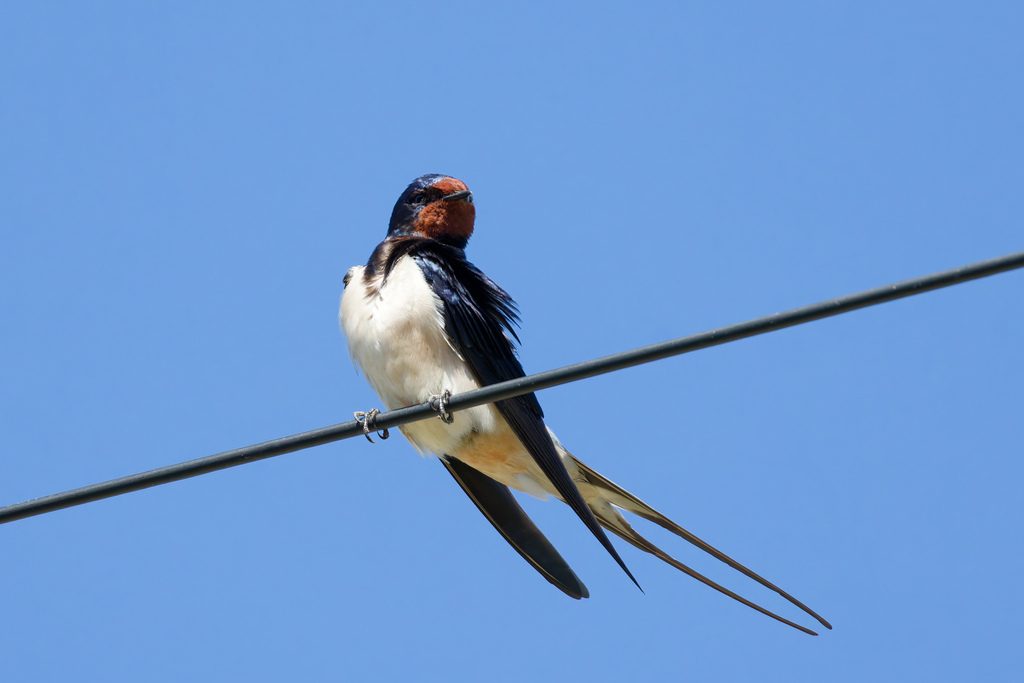
Photo: Donald Davesne · CC BY 4.0 (May be cropped or resized)
Hirundo rustica
Basic stats
Diet
Mainly flying insects, with small amounts of fruit and seed
Habitat
Open country, farmland and human-modified places with sheltered nest sites
Range
Breeds widely across the Northern Hemisphere and winters through much of the Southern Hemisphere
Clutch size
Usually 6 eggs
Incubation period
About 15 days
Size
17–19cm
Wingspan
32–34.5cm
Weight
Averages about 18g
The Barn Swallow is a slim, widely distributed aerial insectivore with glossy blue upperparts, a rufous forehead and throat, and a deeply forked tail. It breeds across much of the Northern Hemisphere, and most subspecies winter over large parts of the Southern Hemisphere. Open country and human-modified landscapes suit it especially well because barns and similar sheltered structures provide nest sites. Adults measure about 17–19 cm, including the elongated outer tail feathers. (Wikipedia, general species account)
The species catches most of its insect prey in flight, although trait data also record small plant components in its diet. A pair builds a cup-shaped nest from mud pellets, usually inside a building or comparable structure, reinforcing the bird’s close association with people. AnAge lists a clutch of six and an incubation period of about 15 days. AVONET’s species mean is about 17.9 g, within the 16–22 g range given in the general account. (EltonTraits, Wilman et al. 2014; AnAge; AVONET, Tobias et al. 2022; Wikipedia, general species account)
Where to see Barn Swallow in Spain
GBIF records grouped by protected area. They show where the species has been reported, not that it is there now, and they are not population counts.
Recorded in 123 protected areas (1964–2026). The 8 with the most records:
- Monfragüe National Park: 3,252 records (1973–2025)
- Parc Agrari del Baix Llobregat: 2,932 records (2000–2026)
- ZEPA Estepas Cerealistas de los ríos Jarama y Henares: 1,802 records (1992–2025)
- Paisaje Protegido Espacios Abiertos e Islas del Mar Menor: 1,324 records (1982–2025)
- LIC-ZEPA Embalse de las Cañas: 1,038 records (1984–2024)
- ZEC-ZEPA Laguna de Pitillas: 974 records (1984–2025)
- Parque Natural de Bahía de Cádiz: 839 records (1985–2024)
- Parc natural d'es Trenc i el Salobrar de Campos: 734 records (1974–2024)
Quick answers
- What does the Barn Swallow eat?
- Mainly flying insects, with small amounts of fruit and seed
- What habitat does the Barn Swallow live in?
- Open country, farmland and human-modified places with sheltered nest sites
- Where is the Barn Swallow found?
- Breeds widely across the Northern Hemisphere and winters through much of the Southern Hemisphere
- How many eggs does the Barn Swallow lay?
- Usually 6 eggs
- How long are the eggs of the Barn Swallow incubated?
- About 15 days
- How big is the Barn Swallow?
- 17–19cm
- What is the wingspan of the Barn Swallow?
- 32–34.5cm
- How much does the Barn Swallow weigh?
- Averages about 18g