
 Wildlife
of Spain
Canary Islands Chiffchaff
Warblers & Kinglets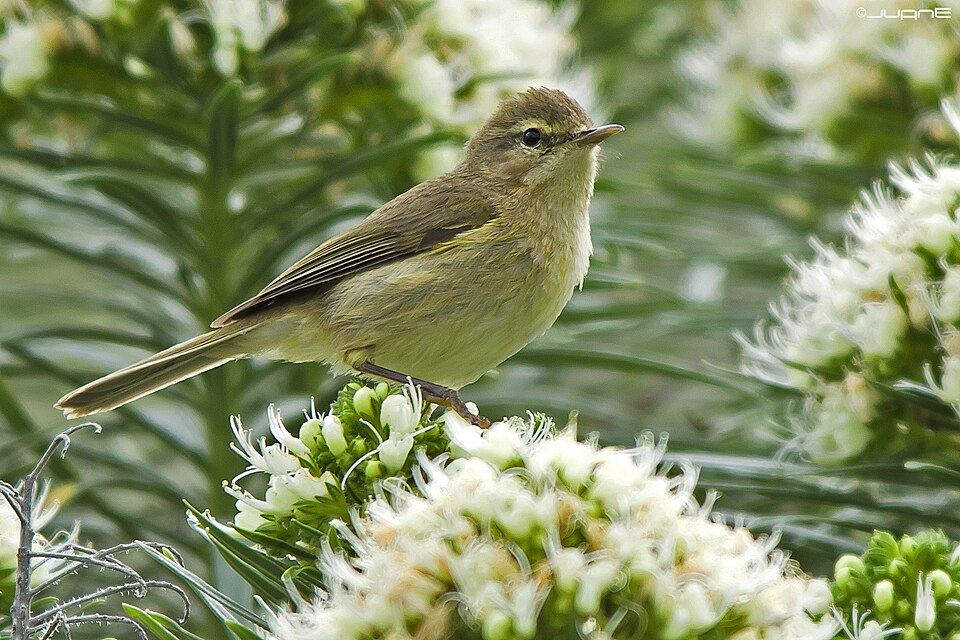
Photo: Juan Emilio from Las Palmas de Gran Canaria, España · CC BY-SA 2.0 (May be cropped or resized)
Phylloscopus canariensis
The Canary Islands chiffchaff is sometimes written as Canary Island chiffchaff. It resembles the common and Iberian chiffchaffs, but compared with the common form it has a longer bill and tail and shorter wings. Its underside is brownish buff, especially over breast and flanks, and its upperparts are darker brown. Many calls resemble those of the common chiffchaff, but its song is harsher, shorter, faster and more varied rather than metronomic. (Wikipedia, general species account)
It occupies most habitats, from coastal gardens to high-elevation vegetation, but avoids low semi-desert scrub. During its January–June breeding season, it is territorial and may be seen singly or in pairs. It lays eggs in a rounded nest with a side entrance, placed near ground level in coastal scrub but at least 8 m up in laurisilva. Clutches contain two to five eggs, and most pairs raise three broods. (Wikipedia, general species account)
Where to see Canary Islands Chiffchaff in Spain
GBIF records grouped by protected area. They show where the species has been reported, not that it is there now, and they are not population counts.
Recorded in 10 protected areas (1966–2025). The 8 with the most records:
- Sebadales del Sur de Tenerife Marine Park: 677 records (1989–2025)
- Paisaje Protegido de los Campeches, Tigaiga y Ruiz: 467 records (1989–2025)
- Zona Exclusion del Monte de Aguirre: 336 records (1969–2024)
- Monumento Natural de la Montaña de Guaza: 102 records (1997–2025)
- Monumento Natural de Bandama: 65 records (2008–2024)
- Paisaje Protegido de Costa de Acentejo: 33 records (2009–2024)
- Monumento Natural del Teide: 28 records (1966–2025)
- Paisaje Protegido de Ifonche: 7 records (1999–2024)