
 Wildlife
of Spain
Eurasian Moorhen
Cranes, Rails & Bustards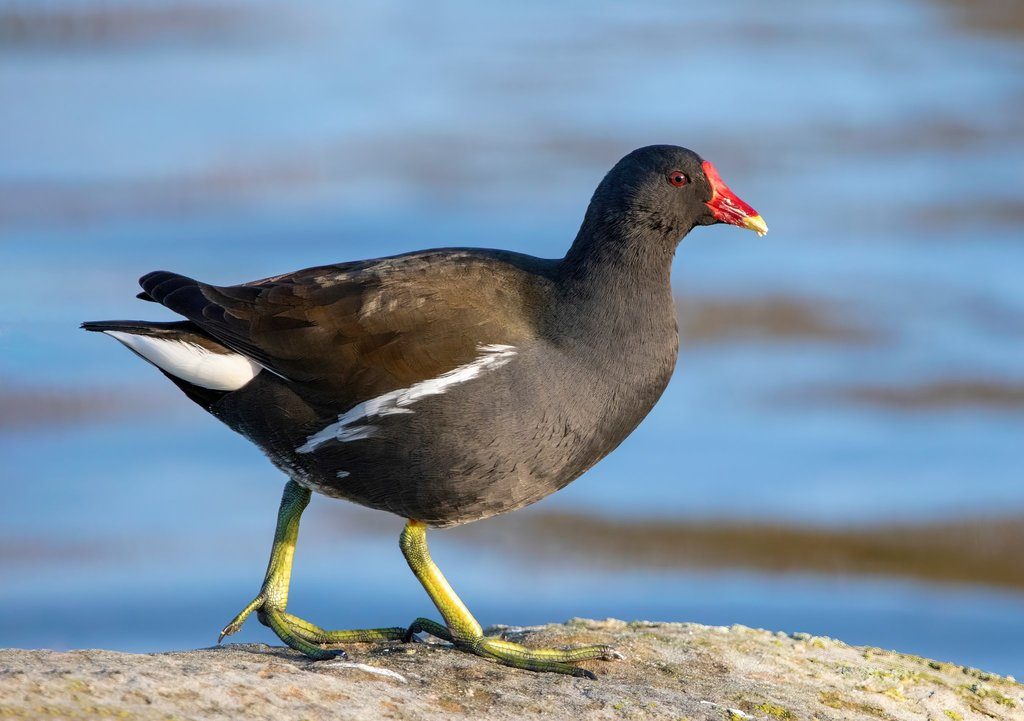
Photo: Alexis Lours · CC BY 4.0 (May be cropped or resized)
Gallinula chloropus
Basic stats
Diet
Aquatic and terrestrial plants, seeds, fruit, invertebrates, fish and other small vertebrates
Habitat
Well-vegetated marshes, ponds, canals and other wetlands
Range
Widely distributed across Europe, Africa and Asia
Clutch size
Usually 9 eggs
Incubation period
About 19 days
Size
30–38cm
Wingspan
50–62cm
Weight
Averages about 340g
The Eurasian Moorhen is a compact rail of well-vegetated wetlands across Europe, Africa and Asia. It frequents marshes, ponds, canals and lake margins, usually staying near cover. Adults are mainly dark slate-grey and brown, with a red frontal shield and bill tipped yellow, a white line along the flank and white under the tail. Long toes spread its weight over soft mud and floating plants, and the bird swims with a characteristic nodding motion. (Wikipedia, general species account)
The species is an adaptable omnivore, taking aquatic and terrestrial vegetation, seeds, fruit, invertebrates, fish and other small vertebrates. It feeds on land, at the surface and among emergent plants. Nests are built from vegetation close to or over water; a typical clutch contains nine eggs, and incubation averages about 19 days. AVONET lists mean mass as about 339.6 g and classifies the species as a non-migratory wetland bird. (Wikipedia, general species account; EltonTraits, Wilman et al. 2014; AnAge; AVONET, Tobias et al. 2022)
Where to see Eurasian Moorhen in Spain
GBIF records grouped by protected area. They show where the species has been reported, not that it is there now, and they are not population counts.
Recorded in 64 protected areas (1964–2026). The 8 with the most records:
- Parc Agrari del Baix Llobregat: 4,310 records (1990–2025)
- Paisaje Protegido Espacios Abiertos e Islas del Mar Menor: 1,000 records (1982–2025)
- Reserva Natural Parcial de la Ría de Villaviciosa: 984 records (1978–2026)
- els Carrissars d'Elx: 917 records (2002–2024)
- LIC-ZEPA Embalse de las Cañas: 608 records (1979–2024)
- ZEC-ZEPA Laguna de Pitillas: 443 records (1996–2025)
- Aragoi ibaiko erdiko tartea HBB - KBE: 415 records (2000–2024)
- ZEPA Carrizales y Sotos de Aranjuez: 360 records (1988–2024)
Quick answers
- What does the Eurasian Moorhen eat?
- Aquatic and terrestrial plants, seeds, fruit, invertebrates, fish and other small vertebrates
- What habitat does the Eurasian Moorhen live in?
- Well-vegetated marshes, ponds, canals and other wetlands
- Where is the Eurasian Moorhen found?
- Widely distributed across Europe, Africa and Asia
- How many eggs does the Eurasian Moorhen lay?
- Usually 9 eggs
- How long are the eggs of the Eurasian Moorhen incubated?
- About 19 days
- How big is the Eurasian Moorhen?
- 30–38cm
- What is the wingspan of the Eurasian Moorhen?
- 50–62cm
- How much does the Eurasian Moorhen weigh?
- Averages about 340g