
 Wildlife
of Spain
Eurasian Nightjar
Swifts & Nightjars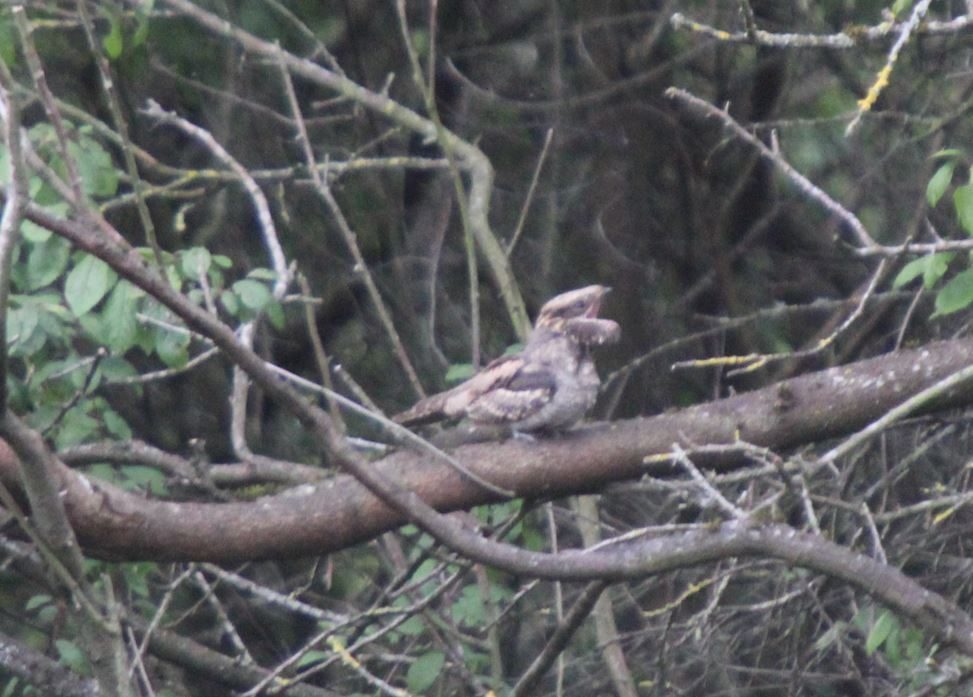
Photo: no rights reserved · CC0
Caprimulgus europaeus
Basic stats
Diet
Flying insects
Habitat
Dry open country, heath, clearings and young woodland
Range
Breeds across Europe and temperate Asia; winters in sub-Saharan Africa
Clutch size
2 eggs
Incubation period
17–21 days
Size
24.5–28cm
Wingspan
52–59cm
Weight
Averages about 67g
The Eurasian Nightjar is a nocturnal aerial insectivore. Its body measures 24.5–28 cm and its wings span 52–59 cm. Intricate grey and brown patterning conceals a resting bird against ground or branch, while males show white wing and tail patches in flight. AVONET and AnAge both give an average adult mass of about 67 g (Wikipedia, general species account; AVONET, Tobias et al. 2022; AnAge).
The species breeds from Europe across temperate Asia and migrates to sub-Saharan Africa. Dry open country with scattered trees is favoured, including heath, clearings and young plantations. Birds seize flying insects at night, often launching from a perch; invertebrates form the entire EltonTraits diet profile. Two eggs lie directly on the ground and hatch after 17–21 days, without a constructed nest (Wikipedia, general species account; EltonTraits, Wilman et al. 2014).
Where to see Eurasian Nightjar in Spain
GBIF records grouped by protected area. They show where the species has been reported, not that it is there now, and they are not population counts.
Recorded in 35 protected areas (1982–2025). The 8 with the most records:
- Parque Nacional Marítimo-Terrestre das Illas Atlánticas de Galicia: 75 records (1990–2025)
- Reserva natural de las Islas Columbretes: 55 records (1985–2024)
- Parc Agrari del Baix Llobregat: 42 records (2010–2025)
- LIC Jaizkibel BGL: 36 records (1990–2024)
- Espai d'interès natural de les Gavarres: 29 records (2005–2025)
- Irati, Urrobi eta Erro Ibaiak KBE: 25 records (2015–2022)
- Reserva natural de Puigventós: 20 records (2004–2020)
- ZEC Peñadil - Montecillo - Monterrey KBE: 20 records (2007–2022)
Quick answers
- What does the Eurasian Nightjar eat?
- Flying insects
- What habitat does the Eurasian Nightjar live in?
- Dry open country, heath, clearings and young woodland
- Where is the Eurasian Nightjar found?
- Breeds across Europe and temperate Asia; winters in sub-Saharan Africa
- How many eggs does the Eurasian Nightjar lay?
- 2 eggs
- How long are the eggs of the Eurasian Nightjar incubated?
- 17–21 days
- How big is the Eurasian Nightjar?
- 24.5–28cm
- What is the wingspan of the Eurasian Nightjar?
- 52–59cm
- How much does the Eurasian Nightjar weigh?
- Averages about 67g