
 Wildlife
of Spain
Eurasian Tree Sparrow
Finches, Sparrows & Buntings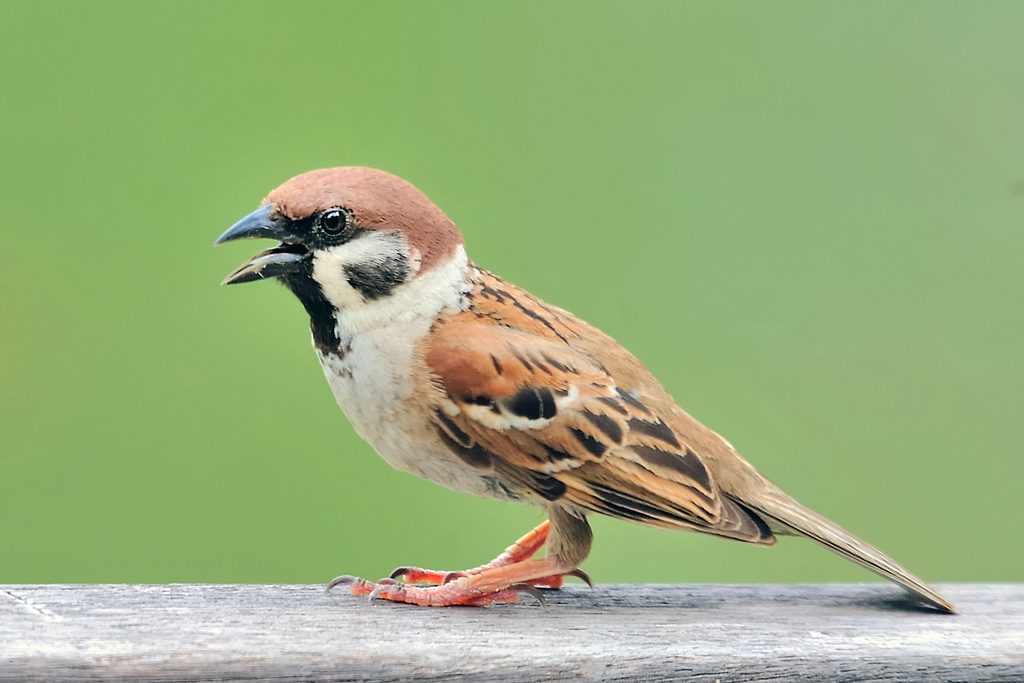
Photo: Yiwenyiwen · CC BY-SA 4.0 (May be cropped or resized)
Passer montanus
Basic stats
Diet
Mostly seeds, supplemented by invertebrates
Habitat
Open countryside with trees, farmland, villages and towns
Range
Native across temperate Eurasia and Southeast Asia; introduced to several regions elsewhere
Clutch size
Usually 5–6 eggs
Incubation period
About 13 days
Size
12.5–14cm
Wingspan
About 21cm
Weight
Averages about 21g
The Eurasian Tree Sparrow is a compact sparrow with a chestnut crown and nape, white cheeks marked by bold black spots, and a black throat. The sexes look alike, while juveniles are duller. Brown, black-streaked upperparts and two narrow pale wingbars complete the pattern. It is smaller than the House Sparrow and lacks that species' grey male crown. Adults measure 12.5–14 cm, span about 21 cm and average about 21 g (Wikipedia, general species account; AVONET, Tobias et al. 2022).
Native across temperate Eurasia and Southeast Asia, the species also has introduced populations elsewhere. It uses lightly wooded farmland and villages widely, while in eastern Asia it commonly occupies towns and cities. Seeds dominate the diet, supplemented by invertebrates, particularly during breeding. Pairs place an untidy nest in a tree cavity, building opening or an abandoned large-bird nest. Five or six eggs are usual, and incubation averages about 13 days (Wikipedia, general species account; EltonTraits, Wilman et al. 2014; AnAge).
Where to see Eurasian Tree Sparrow in Spain
GBIF records grouped by protected area. They show where the species has been reported, not that it is there now, and they are not population counts.
Recorded in 41 protected areas (1961–2026). The 8 with the most records:
- Parc Agrari del Baix Llobregat: 2,868 records (2003–2026)
- Reserva Natural Dirigida de la Laguna de Gallocanta: 1,148 records (1982–2025)
- Zona Periférica de Protección de la Reserva Natural Dirigida de la Laguna de Gallocanta: 668 records (1988–2025)
- ZEPA Estepas Cerealistas de los ríos Jarama y Henares: 428 records (2003–2024)
- els Carrissars d'Elx: 225 records (2011–2024)
- ZEPA Carrizales y Sotos de Aranjuez: 216 records (1990–2024)
- RNP dels Aiguamolls del Baix Ter: 120 records (2005–2026)
- Galacho de Juslibol: 91 records (2006–2024)
Quick answers
- What does the Eurasian Tree Sparrow eat?
- Mostly seeds, supplemented by invertebrates
- What habitat does the Eurasian Tree Sparrow live in?
- Open countryside with trees, farmland, villages and towns
- Where is the Eurasian Tree Sparrow found?
- Native across temperate Eurasia and Southeast Asia; introduced to several regions elsewhere
- How many eggs does the Eurasian Tree Sparrow lay?
- Usually 5–6 eggs
- How long are the eggs of the Eurasian Tree Sparrow incubated?
- About 13 days
- How big is the Eurasian Tree Sparrow?
- 12.5–14cm
- What is the wingspan of the Eurasian Tree Sparrow?
- About 21cm
- How much does the Eurasian Tree Sparrow weigh?
- Averages about 21g