
 Wildlife
of Spain
Horned Grebe
Grebes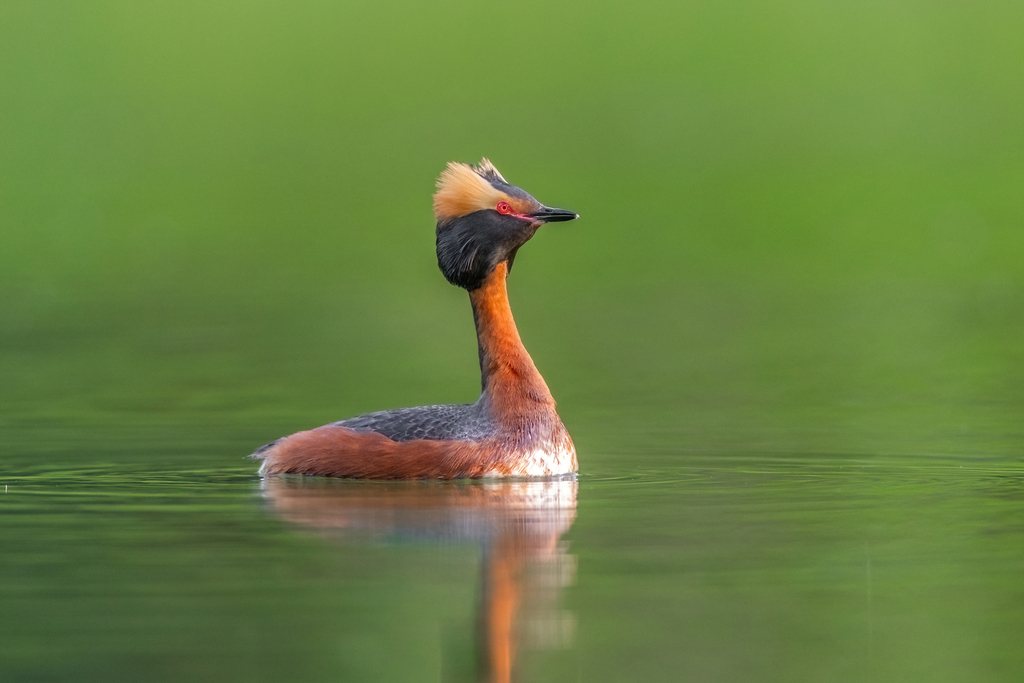
Photo: (c) egorbirder, some rights reserved (CC BY) · CC BY 4.0 (May be cropped or resized)
Podiceps auritus
Basic stats
Diet
Fish and aquatic invertebrates
Habitat
Shallow freshwater ponds and marshes when breeding; sheltered coastal waters and some inland lakes in winter
Range
Northern Eurasia and North America
Clutch size
Averages about 6 eggs
Incubation period
Averages about 24 days
Size
31–38cm
Wingspan
55–74cm
Weight
Averages about 453g
The Horned Grebe is a compact waterbird whose breeding plumage combines a black head and back, chestnut neck and flanks, and erectile golden-orange feather tufts behind the eyes. In winter it becomes sharply black and white and loses these ornamental horns. Its pointed bill has a pale tip, while the forehead is relatively flat. Adults measure 31–38 cm, span 55–74 cm and average about 453 g (Wikipedia, general species account; AVONET, Tobias et al. 2022).
Across northern Eurasia and North America, the species breeds on shallow freshwater ponds, marshes and sheltered lake margins with emergent vegetation. Migrants use rivers and lakes, and many winter around estuaries, bays and protected coasts. It dives using its large feet, taking fish and aquatic invertebrates, with arthropods favoured more in summer and fish more in winter. Courtship includes synchronized displays, and nesting pairs build a platform on the water. Clutches average about six eggs, with incubation averaging roughly 24 days (Wikipedia, general species account; EltonTraits, Wilman et al. 2014; AnAge).
Where to see Horned Grebe in Spain
GBIF records grouped by protected area. They show where the species has been reported, not that it is there now, and they are not population counts.
Recorded in 3 protected areas (1973–2021).
- Zona Húmida Protexida Ría de Ortigueira e Ladrido: 121 records (1996–2020)
- Reserva Natural Parcial de la Ría de Villaviciosa: 6 records (1973–2007)
- Zona Húmida Protexida Ría de Ribadeo: 4 records (2003–2021)
Quick answers
- What does the Horned Grebe eat?
- Fish and aquatic invertebrates
- What habitat does the Horned Grebe live in?
- Shallow freshwater ponds and marshes when breeding; sheltered coastal waters and some inland lakes in winter
- Where is the Horned Grebe found?
- Northern Eurasia and North America
- How many eggs does the Horned Grebe lay?
- Averages about 6 eggs
- How long are the eggs of the Horned Grebe incubated?
- Averages about 24 days
- How big is the Horned Grebe?
- 31–38cm
- What is the wingspan of the Horned Grebe?
- 55–74cm
- How much does the Horned Grebe weigh?
- Averages about 453g