
 Wildlife
of Spain
Lissotriton helveticus
Newts & Salamanders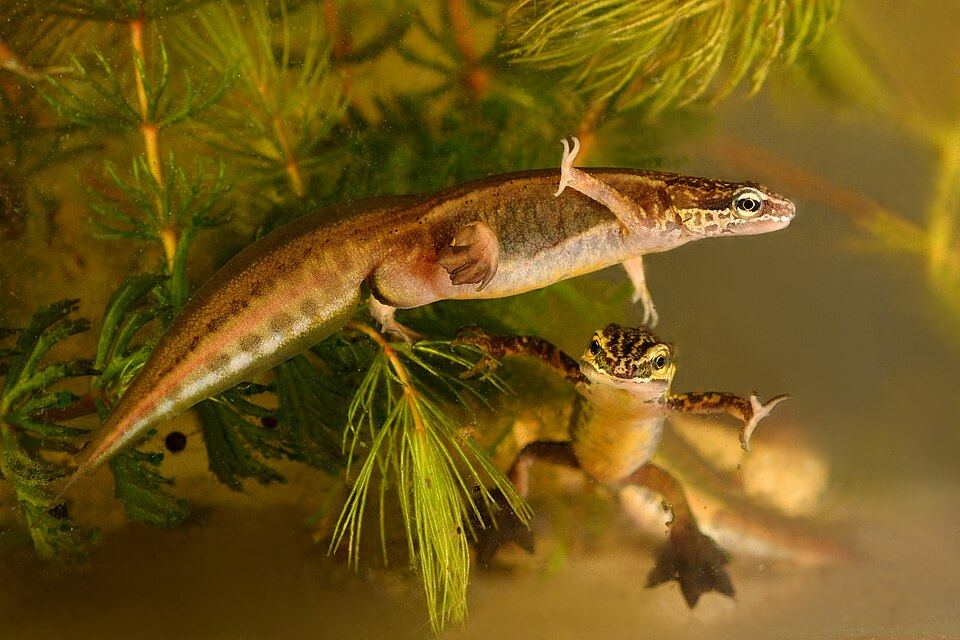
Photo: Gilles San Martin from Namur, Belgium · CC BY-SA 2.0 (May be cropped or resized)
Lissotriton helveticus
The palmate newt, Lissotriton helveticus, occurs in western Europe, stretching from Britain to the north of Iberia. It measures 5–9.5 cm and is olive or brown with dark spots, a yellow-orange underside, and a dark stripe passing through the eyes. The throat is unspotted. Breeding males develop a low back crest, strongly webbed hind feet, and a distinct filament at the tail tip. (Wikipedia, general species account)
The newts use forests, marshes, pastures, and gardens; on land they are mainly nocturnal. After spring emergence from hibernation, they move to still, fish-free water to breed. Males perform a courtship display and deposit a spermatophore for the female to collect. Larvae develop for 1.5–3.5 months before becoming terrestrial juveniles. Sexual maturity comes at two to three years, and wild individuals may live up to 12 years. (Wikipedia, general species account)