
 Wildlife
of Spain
Ring-necked Pheasant
Gamebirds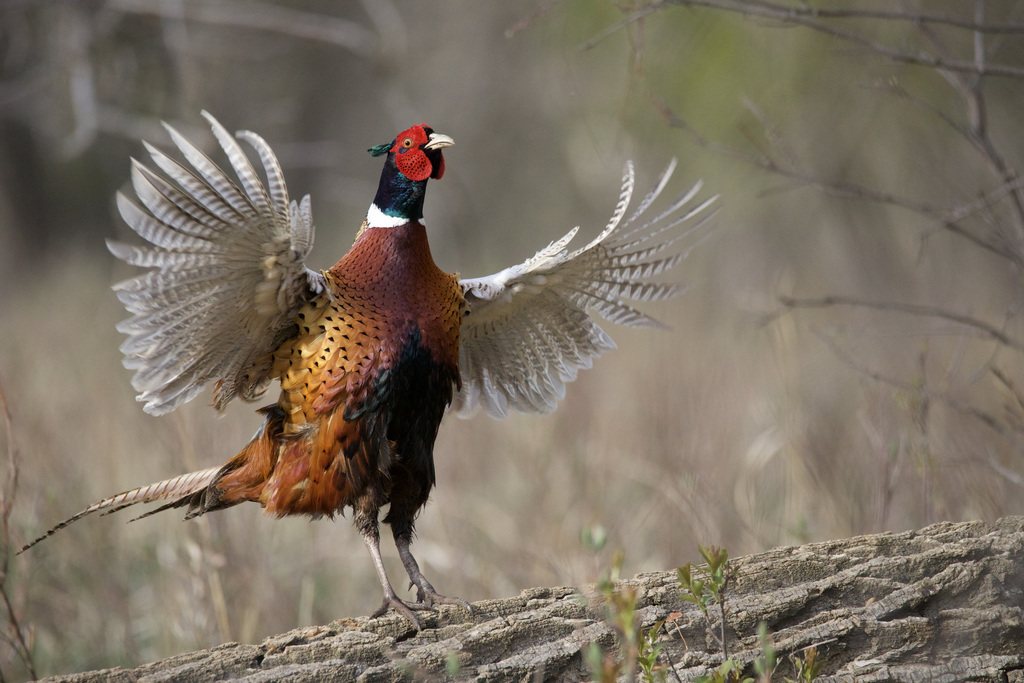
Photo: (c) John Krampl, some rights reserved (CC BY) · CC BY 4.0 (May be cropped or resized)
Phasianus colchicus
Basic stats
Diet
Fruit, seeds and other plant material, with some invertebrates
Habitat
Farmland, grassland, scrub and woodland edge
Range
Native from southeastern Europe across temperate Asia; introduced widely elsewhere
Clutch size
About 11 eggs
Incubation period
About 24 days
Weight
Averages about 1120g
The Ring-necked Pheasant belongs to a highly variable species whose males are large, long-tailed and vividly coloured, while females are smaller and mottled brown. Many males in the ring-necked group carry a white collar separating the glossy dark head from the coppery body, though plumage differs among subspecies and introduced mixtures. The species is strongly terrestrial and averages about 1,120 g (Wikipedia, general species account; AVONET, Tobias et al. 2022).
Native populations extend from southeastern Europe across temperate Asia, while releases for hunting have established the species widely elsewhere. It uses farmland, grassland, scrub and woodland margins, feeding on the ground. Fruit, seeds and other plant material dominate the diet; invertebrates are also eaten and independently supported by the species account despite their smaller EltonTraits share. Dataset means indicate about eleven eggs and an incubation period near 24 days (Wikipedia, general species account; EltonTraits, Wilman et al. 2014; AnAge).
Where to see Ring-necked Pheasant in Spain
GBIF records grouped by protected area. They show where the species has been reported, not that it is there now, and they are not population counts.
Recorded in 11 protected areas (1991–2026). The 8 with the most records:
- Parc Agrari del Baix Llobregat: 685 records (2000–2026)
- ZEPA Carrizales y Sotos de Aranjuez: 29 records (2015–2024)
- Parc natural d'es Trenc i el Salobrar de Campos: 20 records (1991–2024)
- LIC Jaizkibel BGL: 18 records (1993–2024)
- els Carrissars d'Elx: 8 records (2017–2024)
- RNP dels Aiguamolls del Baix Ter: 6 records (2016–2026)
- ZEC-ZEPA Laguna de Pitillas: 6 records (2008–2019)
- Reserva Natural Lagunas de El Longar, Altillo Grande y Altillo Chica: 4 records (2022)
Quick answers
- What does the Ring-necked Pheasant eat?
- Fruit, seeds and other plant material, with some invertebrates
- What habitat does the Ring-necked Pheasant live in?
- Farmland, grassland, scrub and woodland edge
- Where is the Ring-necked Pheasant found?
- Native from southeastern Europe across temperate Asia; introduced widely elsewhere
- How many eggs does the Ring-necked Pheasant lay?
- About 11 eggs
- How long are the eggs of the Ring-necked Pheasant incubated?
- About 24 days
- How much does the Ring-necked Pheasant weigh?
- Averages about 1120g