
 Wildlife
of Spain
Snowy Owl
Owls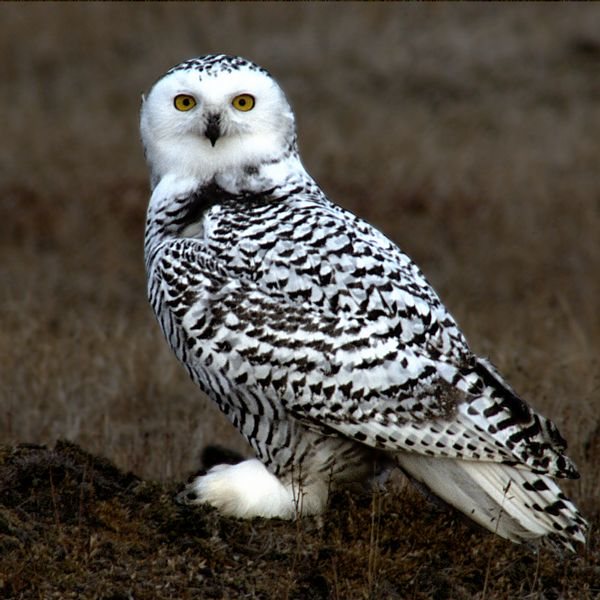
Photo: Floyd Davidson · CC BY-SA 4.0 (May be cropped or resized)
Bubo scandiacus
Basic stats
Diet
Mostly small vertebrates
Habitat
Arctic tundra and open non-breeding landscapes
Range
Arctic North America and Eurasia, with irregular winter movements southward
Clutch size
Averages about 6 eggs
Incubation period
About 32 days
Size
About 52–71cm
Weight
Averages about 2029g
The Snowy Owl is a large Arctic owl whose white plumage is variably barred or spotted dark brown. Adult males tend to become whiter with age, whereas females usually retain heavier markings. Dense feathering covers the legs and feet. AVONET records an average mass of about 2,029 g, closely matching AnAge. Unlike most owls, it often hunts in daylight during the continuous light of Arctic summer (Wikipedia, general species account; AVONET, Tobias et al. 2022; AnAge).
It breeds across tundra in Arctic North America and Eurasia and moves irregularly south in winter as prey conditions change. Small vertebrates account for 90% of the EltonTraits diet profile. Lemmings dominate in many breeding areas, while other mammals and birds broaden the diet outside that season. The owl usually watches from a low perch or the ground before flying toward prey. AnAge reports an average clutch near six eggs and incubation of about 32 days (Wikipedia, general species account; EltonTraits, Wilman et al. 2014; AnAge).
Quick answers
- What does the Snowy Owl eat?
- Mostly small vertebrates
- What habitat does the Snowy Owl live in?
- Arctic tundra and open non-breeding landscapes
- Where is the Snowy Owl found?
- Arctic North America and Eurasia, with irregular winter movements southward
- How many eggs does the Snowy Owl lay?
- Averages about 6 eggs
- How long are the eggs of the Snowy Owl incubated?
- About 32 days
- How big is the Snowy Owl?
- About 52–71cm
- How much does the Snowy Owl weigh?
- Averages about 2029g