
 Wildlife
of Spain
Greater Flamingo
Flamingos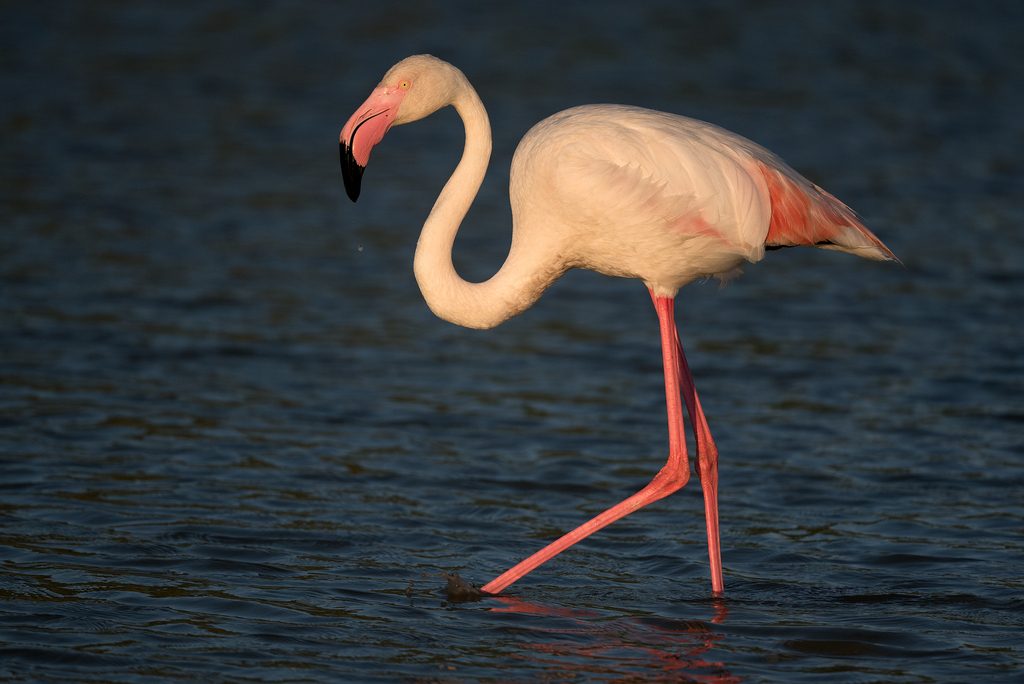
Photo: Pierre-Marie Epiney · CC BY-SA 4.0 (May be cropped or resized)
Phoenicopterus roseus
Basic stats
Diet
Algae, diatoms, aquatic plants, seeds, crustaceans, mollusks, worms, and aquatic insect larvae
Habitat
Shallow saline or alkaline lagoons, salt lakes, estuaries, mudflats, and coastal wetlands
Range
Africa, southern Europe, the Middle East, and southern and southwestern Asia
Clutch size
Usually 1 egg
Incubation period
27–31 days
Size
Approximately 120–145 cm
Wingspan
Approximately 140–165 cm
Weight
Approximately 2.1–4.1 kg
The greater flamingo occurs across Africa, southern Europe, the Middle East, and southern and southwestern Asia. It frequents broad, shallow saline or alkaline wetlands, including coastal lagoons, salt lakes, estuaries, and mudflats. Adults stand approximately 120–145 cm tall and have a wingspan of roughly 140–165 cm. Their pale pink plumage, extremely long legs and neck, black-tipped down-curved bill, and crimson wing coverts make them unmistakable. Males are generally larger than females, though their plumage is similar. (Animal Diversity Web)
Greater flamingos filter algae, diatoms, seeds, aquatic vegetation, crustaceans, mollusks, worms, and insect larvae from water and soft sediment using specialized plates inside the bill. They are highly social and breed in large colonies following synchronized group displays. Both members of a pair construct a raised mud nest and usually produce a single egg. Incubation is shared and lasts twenty-seven to thirty-one days. After hatching, the chick is fed nutrient-rich crop secretion by both parents before joining communal groups of young birds. (Animal Diversity Web)
Where to see Greater Flamingo in Spain
GBIF records grouped by protected area. They show where the species has been reported, not that it is there now, and they are not population counts.
Recorded in 29 protected areas (1964–2026). The 8 with the most records:
- Reserva Natural Dirigida de la Laguna de Gallocanta: 1,492 records (2003–2026)
- Paisaje Protegido Espacios Abiertos e Islas del Mar Menor: 1,285 records (1986–2025)
- Parque Natural de Bahía de Cádiz: 1,173 records (1985–2026)
- Parc natural d'es Trenc i el Salobrar de Campos: 1,159 records (1978–2026)
- els Carrissars d'Elx: 956 records (1999–2024)
- Zona Periférica de Protección de la Reserva Natural Dirigida de la Laguna de Gallocanta: 952 records (2010–2026)
- Parque Natural de la Bahía de Cádiz: 673 records (1983–2025)
- Reserva Natural Laguna Salada de Pétrola: 471 records (1993–2026)
Quick answers
- What does the Greater Flamingo eat?
- Algae, diatoms, aquatic plants, seeds, crustaceans, mollusks, worms, and aquatic insect larvae
- What habitat does the Greater Flamingo live in?
- Shallow saline or alkaline lagoons, salt lakes, estuaries, mudflats, and coastal wetlands
- Where is the Greater Flamingo found?
- Africa, southern Europe, the Middle East, and southern and southwestern Asia
- How many eggs does the Greater Flamingo lay?
- Usually 1 egg
- How long are the eggs of the Greater Flamingo incubated?
- 27–31 days
- How big is the Greater Flamingo?
- Approximately 120–145 cm
- What is the wingspan of the Greater Flamingo?
- Approximately 140–165 cm
- How much does the Greater Flamingo weigh?
- Approximately 2.1–4.1 kg