
 Wildlife
of Spain
Black-crowned Night Heron
Herons, Storks, Ibises & Pelicans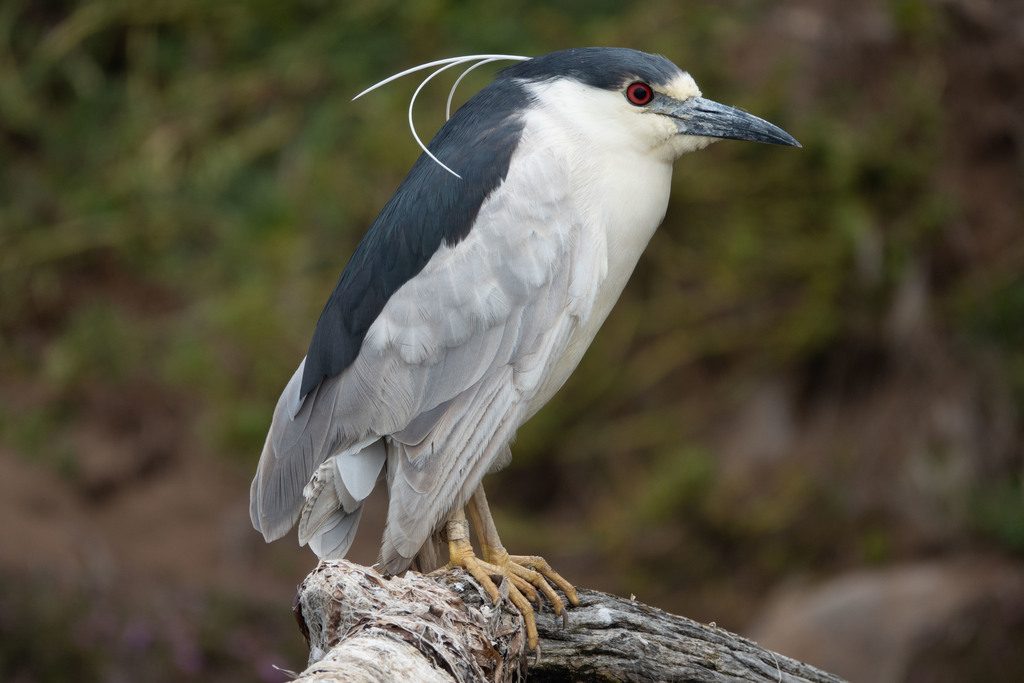
Photo: Kyle Nessen · CC0 1.0
Nycticorax nycticorax
Basic stats
Diet
Fish, aquatic invertebrates and other small vertebrates
Habitat
Wetlands and watersides, often with trees or dense cover for daytime roosting and colonial nesting
Range
Widely distributed through parts of Africa, Asia, Europe and the Americas
Clutch size
Usually 4 eggs
Incubation period
About 25 days
Weight
Averages about 810g
The Black-crowned Night Heron is a stocky, medium-sized heron distributed through much of Africa, Asia, Europe and the Americas. Adults have a black crown and back, grey wings, pale underparts, red eyes and relatively short yellow legs; young birds are browner and heavily streaked. Its compact shape and habit of resting in trees or dense cover by day contrast with the long-necked outline of many other herons. (Wikipedia, general species account)
The species becomes most active around evening and at night, feeding beside water on fish, aquatic invertebrates and other small vertebrates. It often stands still at the water’s edge before striking, although it can also walk slowly while searching. Breeding is colonial, commonly in waterside vegetation or trees, and colonies may be shared with other waterbirds. AnAge records a typical clutch of four and incubation of about 25 days; AVONET gives mean mass as about 810 g. (Wikipedia, general species account; AnAge; AVONET, Tobias et al. 2022)
Where to see Black-crowned Night Heron in Spain
GBIF records grouped by protected area. They show where the species has been reported, not that it is there now, and they are not population counts.
Recorded in 34 protected areas (1955–2025). The 8 with the most records:
- Parc Agrari del Baix Llobregat: 867 records (2011–2025)
- els Carrissars d'Elx: 217 records (2002–2024)
- Paisaje Protegido Corredor Verde del Guadiamar: 175 records (1972–2024)
- LIC-ZEPA Embalse de las Cañas: 158 records (1984–2023)
- Paisaje Protegido Espacios Abiertos e Islas del Mar Menor: 133 records (2002–2025)
- LIC Río Ebro: 120 records (1994–2024)
- Pinar de la Algaida: 60 records (2003–2024)
- Galacho de Juslibol: 52 records (2008–2024)
Quick answers
- What does the Black-crowned Night Heron eat?
- Fish, aquatic invertebrates and other small vertebrates
- What habitat does the Black-crowned Night Heron live in?
- Wetlands and watersides, often with trees or dense cover for daytime roosting and colonial nesting
- Where is the Black-crowned Night Heron found?
- Widely distributed through parts of Africa, Asia, Europe and the Americas
- How many eggs does the Black-crowned Night Heron lay?
- Usually 4 eggs
- How long are the eggs of the Black-crowned Night Heron incubated?
- About 25 days
- How much does the Black-crowned Night Heron weigh?
- Averages about 810g