
 Wildlife
of Spain
Eurasian Wigeon
Ducks, Geese & Swans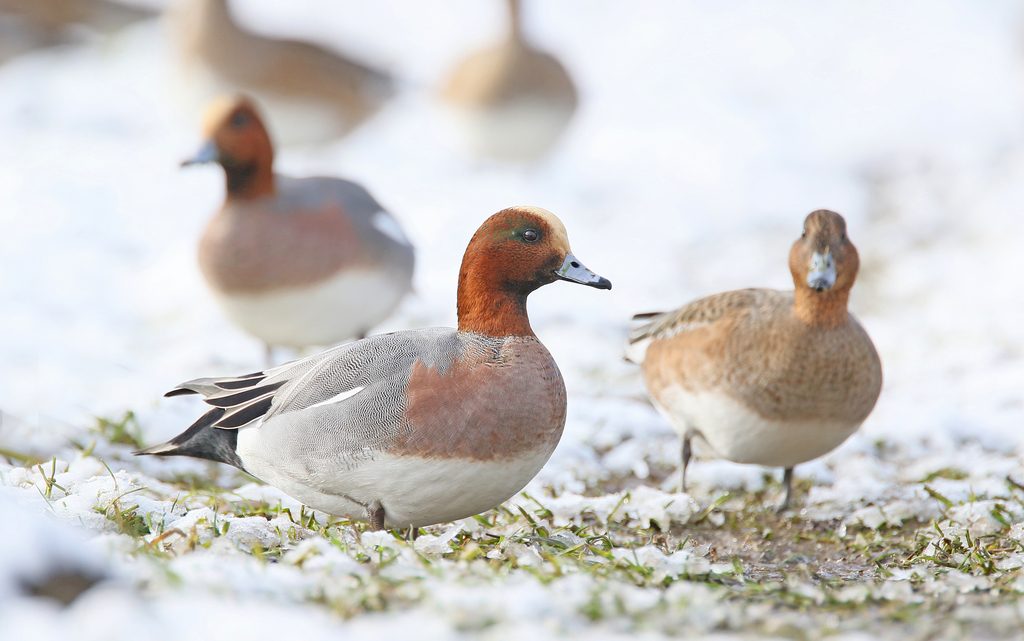
Photo: Christoph Moning · CC BY 4.0 (May be cropped or resized)
Mareca penelope
Basic stats
Diet
Aquatic vegetation and seeds
Habitat
Lakes, marshes, flooded grassland, estuaries and sheltered coasts
Range
Breeds across northern Eurasia; winters in western Europe, Africa and southern Asia
Clutch size
Averages about 8 eggs
Incubation period
About 24 days
Weight
Averages about 770g
The Eurasian Wigeon is a compact dabbling duck with a short grey-blue bill. Breeding males have a chestnut head, creamy forehead, grey body and dark rear, while females are variably warm brown or grey-brown. Both sexes show a white belly, and males reveal bold white wing patches in flight. Its whistling call is a familiar feature of winter flocks (Wikipedia, general species account).
Across the Palearctic, the species breeds beside northern wetlands and migrates to milder waters in western Europe, Africa and southern Asia. It feeds heavily on aquatic plants and also takes seeds, grazing on damp grassland as well as dabbling in shallow water (EltonTraits, Wilman et al. 2014). AnAge reports an average clutch of eight eggs and incubation near 24 days. AVONET's mean mass is about 770 g, higher than the adult figure in AnAge (AnAge; AVONET, Tobias et al. 2022).
Where to see Eurasian Wigeon in Spain
GBIF records grouped by protected area. They show where the species has been reported, not that it is there now, and they are not population counts.
Recorded in 34 protected areas (1975–2025). The 8 with the most records:
- ZEC-ZEPA Laguna de Pitillas: 557 records (1978–2024)
- Zona Húmida Protexida Ría de Ortigueira e Ladrido: 431 records (1988–2024)
- Reserva Natural Dirigida de la Laguna de Gallocanta: 422 records (1982–2024)
- Reserva Natural Parcial de la Ría de Villaviciosa: 221 records (1975–2025)
- Zona Periférica de Protección de la Reserva Natural Dirigida de la Laguna de Gallocanta: 205 records (2012–2024)
- LIC-ZEPA Embalse de las Cañas: 165 records (1980–2024)
- Zona Húmida Protexida Ría de Ribadeo: 113 records (1987–2024)
- Parque Natural Bahía de Cádiz: 73 records (2008–2024)
Quick answers
- What does the Eurasian Wigeon eat?
- Aquatic vegetation and seeds
- What habitat does the Eurasian Wigeon live in?
- Lakes, marshes, flooded grassland, estuaries and sheltered coasts
- Where is the Eurasian Wigeon found?
- Breeds across northern Eurasia; winters in western Europe, Africa and southern Asia
- How many eggs does the Eurasian Wigeon lay?
- Averages about 8 eggs
- How long are the eggs of the Eurasian Wigeon incubated?
- About 24 days
- How much does the Eurasian Wigeon weigh?
- Averages about 770g