
 Wildlife
of Spain
Muscovy Duck
Ducks, Geese & Swans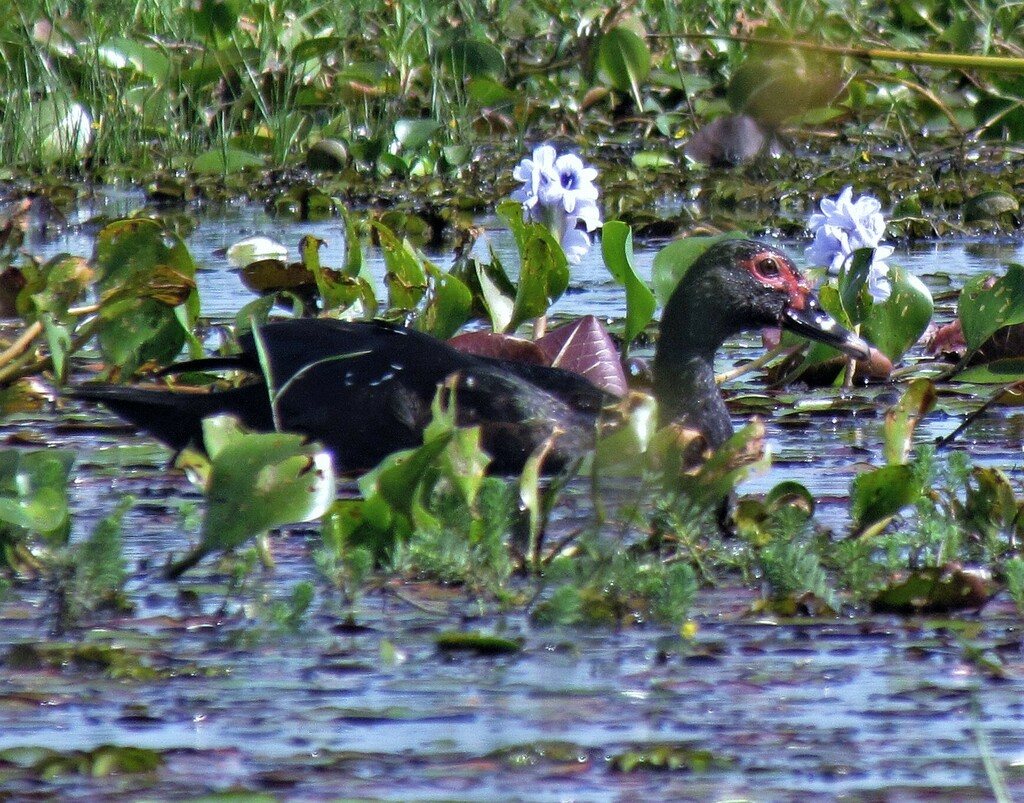
Photo: no rights reserved · CC0 1.0
Cairina moschata
Basic stats
Diet
Seeds, plant material, insects and other invertebrates
Habitat
Wooded freshwater wetlands, swamps, streams and nearby grassland
Range
Native from Mexico through Central America to tropical South America
Size
66–84cm
Wingspan
137–152cm
Weight
Averages about 2416g
The wild Muscovy Duck is a large, heavy-bodied duck with glossy dark plumage, bold white wing patches and bare reddish facial skin, especially extensive in males. Males are substantially larger than females and may carry a low crest; both sexes have strong claws suited to perching. Domestic birds occur in many colour forms, but those do not represent the standard wild appearance. The species measures about 66–84 cm, spans 137–152 cm and averages about 2,416 g (Wikipedia, general species account; AVONET, Tobias et al. 2022).
Across its native range from Mexico through Central America to tropical South America, the species inhabits wooded swamps, slow streams, ponds and nearby grassland. It feeds both on land and in shallow water, taking seeds and other plant matter together with insects and other invertebrates. Wild birds commonly roost in trees. Nesting usually occurs in a tree cavity or other sheltered hollow, and the female alone incubates and tends the brood (Wikipedia, general species account; EltonTraits, Wilman et al. 2014).
Where to see Muscovy Duck in Spain
GBIF records grouped by protected area. They show where the species has been reported, not that it is there now, and they are not population counts.
Recorded in 18 protected areas (2006–2024). The 8 with the most records:
- Parque Regional El Valle y Carrascoy: 59 records (2020–2024)
- Salina de Carboneros: 39 records (2018–2024)
- Paraje Natural Río Palmones: 30 records (2016–2024)
- Parc Agrari del Baix Llobregat: 20 records (2011–2024)
- Paisaje Protegido de los Campeches, Tigaiga y Ruiz: 18 records (2017–2024)
- ZEPA Estepas Cerealistas de los ríos Jarama y Henares: 18 records (2020–2024)
- Paisaje Protegido Corredor Verde del Guadiamar: 17 records (2022–2024)
- Marjal i Estany de la Ribera Sud del Xúquer: 14 records (2018–2024)
Quick answers
- What does the Muscovy Duck eat?
- Seeds, plant material, insects and other invertebrates
- What habitat does the Muscovy Duck live in?
- Wooded freshwater wetlands, swamps, streams and nearby grassland
- Where is the Muscovy Duck found?
- Native from Mexico through Central America to tropical South America
- How big is the Muscovy Duck?
- 66–84cm
- What is the wingspan of the Muscovy Duck?
- 137–152cm
- How much does the Muscovy Duck weigh?
- Averages about 2416g