
 Wildlife
of Spain
European Stonechat
Thrushes, Chats & Flycatchers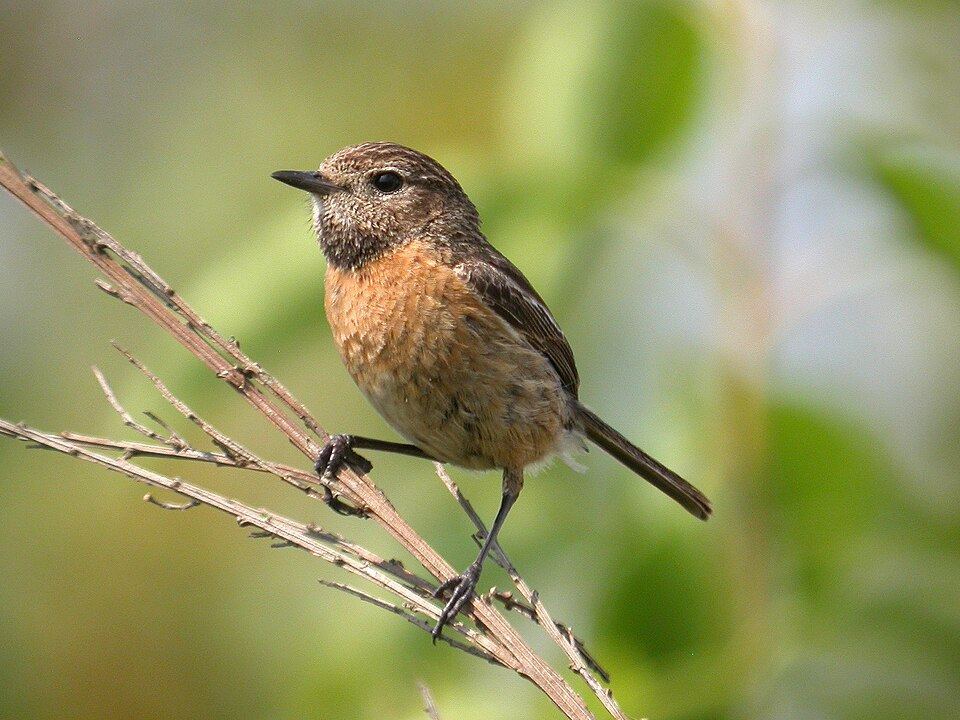
Photo: Frank Vassen from Brussels, Belgium · CC BY 2.0 (May be cropped or resized)
Saxicola rubicola
Once placed in the thrush family Turdidae, the European stonechat and its relatives are now assigned, based on genetic evidence, to Muscicapidae, the Old World flycatchers. It ranges across Europe east to Ukraine and the South Caucasus, as well as parts of North Africa. The whinchat and Siberian stonechat are more migratory and have longer wings than either sex of the European stonechat. Summer males have black upperparts and head, orange throat and breast, and white belly and vent. (Wikipedia, general species account)
A white half-collar marks the neck sides; the wings have a small white scapular patch and the rump a tiny white patch, often streaked black. Females have brown heads and upperparts, with dark-brown streaking over paler brown where males have white neck, rump and belly patches. Their only white is on the wing scapulars, and even that may be buff-white. Subspecies differ in color intensity in line with Gloger’s rule. (Wikipedia, general species account)
Where to see European Stonechat in Spain
GBIF records grouped by protected area. They show where the species has been reported, not that it is there now, and they are not population counts.
Recorded in 117 protected areas (1960–2026). The 8 with the most records:
- Parc Agrari del Baix Llobregat: 2,313 records (2008–2025)
- ZEPA Estepas Cerealistas de los ríos Jarama y Henares: 1,703 records (2001–2026)
- Reserva Natural Dirigida de la Laguna de Gallocanta: 1,426 records (1991–2025)
- Reserva Natural Parcial de la Ría de Villaviciosa: 1,298 records (1982–2026)
- Parc natural d'es Trenc i el Salobrar de Campos: 1,278 records (1974–2026)
- Monfragüe National Park: 1,093 records (1985–2025)
- Paisaje Protegido Espacios Abiertos e Islas del Mar Menor: 1,009 records (1982–2025)
- ZEC-ZEPA Laguna de Pitillas: 899 records (1996–2024)