
 Wildlife
of Spain
Red-capped Lark
Larks, Pipits & Wagtails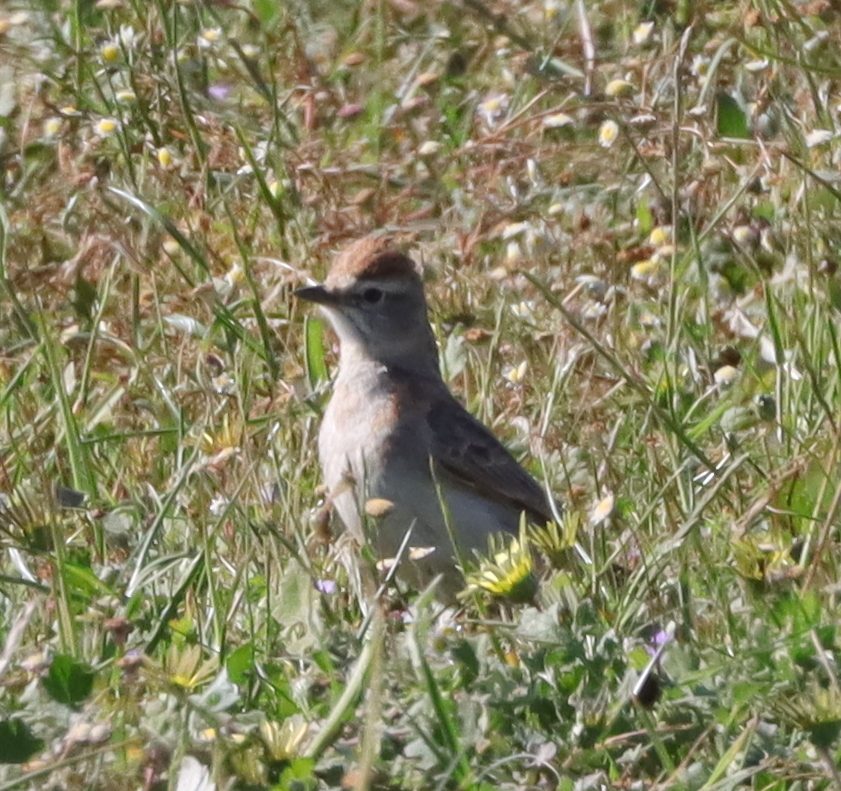
Photo: (c) Cecile Roux, some rights reserved (CC BY-SA) · CC-BY-SA (May be cropped or resized)
Calandrella cinerea
Basic stats
Diet
Seeds and invertebrates
Habitat
Short grassland and fallow fields
Range
Eastern and southern Africa
Clutch size
2–3 eggs
Incubation period
12–15 days
Size
14–15cm
Weight
Averages about 24g
The Red-capped Lark is a 14–15 cm bird of eastern and southern Africa. Adults have a rufous crown, white underparts and red shoulder patches, while juveniles lack the red areas and show spotting. AVONET records an average mass of about 24 g and classifies it as a partly migratory, terrestrial grassland granivore (Wikipedia, general species account; AVONET, Tobias et al. 2022).
Seeds make up 60% and invertebrates 40% of its EltonTraits diet profile. Birds forage on bare earth or very short grass, advancing in brief runs as they collect food. An open cup is set into the ground beside a grass tuft, stone or mound. Clutches contain two or three eggs, incubated by the female for 12–15 days (Wikipedia, general species account; EltonTraits, Wilman et al. 2014).
Quick answers
- What does the Red-capped Lark eat?
- Seeds and invertebrates
- What habitat does the Red-capped Lark live in?
- Short grassland and fallow fields
- Where is the Red-capped Lark found?
- Eastern and southern Africa
- How many eggs does the Red-capped Lark lay?
- 2–3 eggs
- How long are the eggs of the Red-capped Lark incubated?
- 12–15 days
- How big is the Red-capped Lark?
- 14–15cm
- How much does the Red-capped Lark weigh?
- Averages about 24g