
 Wildlife
of Spain
Zitting Cisticola
Warblers & Kinglets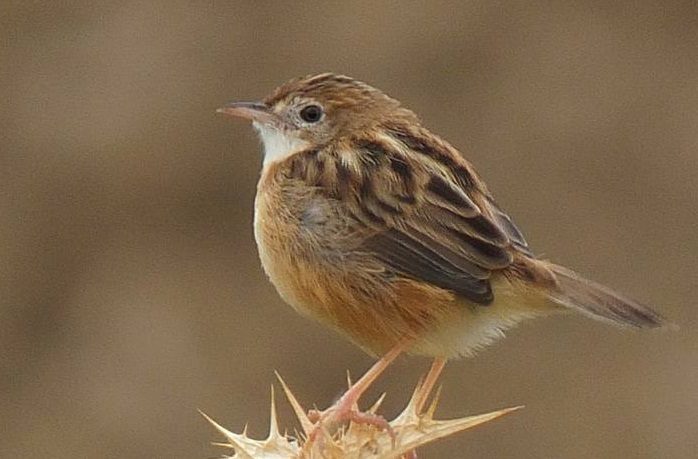
Photo: Karim Haddad · CC BY 4.0 (May be cropped or resized)
Cisticola juncidis
Basic stats
Diet
Mostly invertebrates, with seeds
Habitat
Grassland, marshy vegetation and cultivated fields
Range
Southern Europe, Africa, southern Asia and northern Australia
Clutch size
3–6 eggs
Incubation period
About 10 days
Size
10–12cm
Weight
Averages about 7g
The Zitting Cisticola is a 10–12 cm grassland songbird, brown above with heavy dark streaking and whitish below. Its broad tail has white tips and is frequently flicked, while the rump is warm rufous. Sexes differ only subtly, and numerous geographic forms retain the same general pattern. Displaying males trace an irregular course above the grass, repeating the short call that inspired the English name (Wikipedia, general species account).
Across southern Europe, Africa, southern Asia and northern Australia, the species lives mainly in grasslands, often near water. Invertebrates dominate its diet, with seeds forming a smaller documented component (EltonTraits, Wilman et al. 2014). The male begins a nest low among grasses, binding living leaves around a soft cup, and a receptive female completes it. Clutches contain 3–6 eggs, which hatch after roughly 10 days; breeding often follows seasonal rain (Wikipedia, general species account).
Where to see Zitting Cisticola in Spain
GBIF records grouped by protected area. They show where the species has been reported, not that it is there now, and they are not population counts.
Recorded in 73 protected areas (1964–2026). The 8 with the most records:
- Parc Agrari del Baix Llobregat: 3,744 records (1990–2026)
- ZEC-ZEPA Laguna de Pitillas: 1,307 records (1984–2025)
- LIC-ZEPA Embalse de las Cañas: 1,293 records (1989–2024)
- Paisaje Protegido Espacios Abiertos e Islas del Mar Menor: 1,067 records (1982–2024)
- Reserva Natural Parcial de la Ría de Villaviciosa: 1,010 records (1981–2026)
- Parc natural d'es Trenc i el Salobrar de Campos: 874 records (1975–2024)
- Parque Natural de Bahía de Cádiz: 811 records (1973–2024)
- ZEPA Estepas Cerealistas de los ríos Jarama y Henares: 649 records (1997–2026)
Quick answers
- What does the Zitting Cisticola eat?
- Mostly invertebrates, with seeds
- What habitat does the Zitting Cisticola live in?
- Grassland, marshy vegetation and cultivated fields
- Where is the Zitting Cisticola found?
- Southern Europe, Africa, southern Asia and northern Australia
- How many eggs does the Zitting Cisticola lay?
- 3–6 eggs
- How long are the eggs of the Zitting Cisticola incubated?
- About 10 days
- How big is the Zitting Cisticola?
- 10–12cm
- How much does the Zitting Cisticola weigh?
- Averages about 7g