
 Wildlife
of Spain
Bar-tailed Godwit
Waders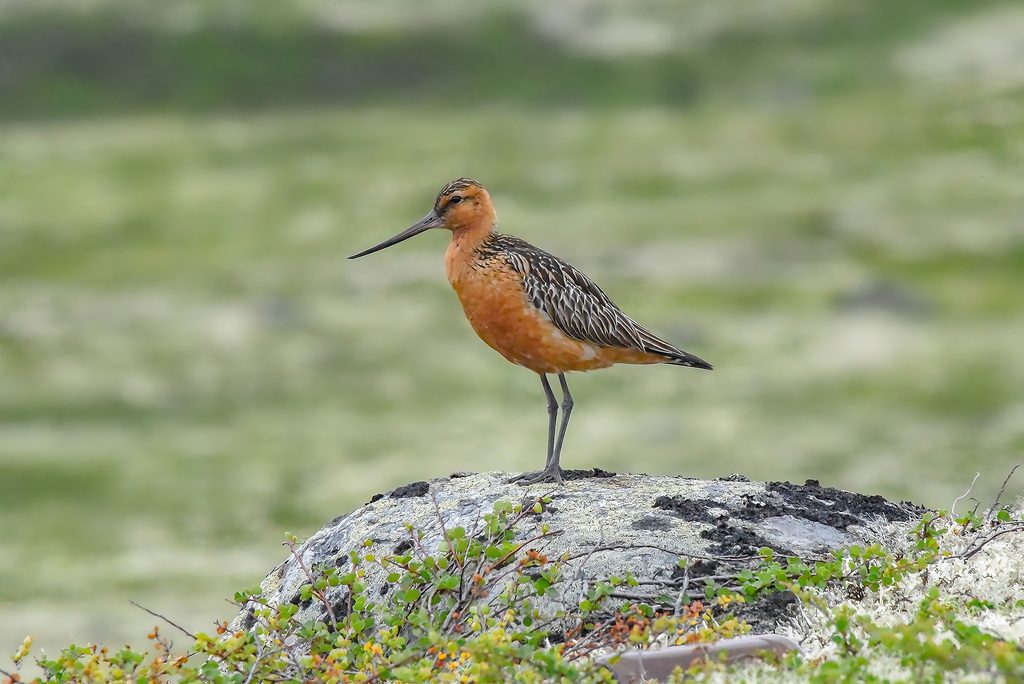
Photo: Настя Бухвалова · CC BY 4.0 (May be cropped or resized)
Limosa lapponica
Basic stats
Diet
Mostly invertebrates, with some berries and seeds
Habitat
Arctic tundra when breeding; estuaries, tidal flats and sheltered coasts at other seasons
Range
Breeds across Arctic Eurasia and Alaska; winters on coasts from western Eurasia and Africa to Australasia
Clutch size
Usually 4 eggs
Incubation period
About 21 days
Weight
Averages about 292g
The Bar-tailed Godwit is a large wader with long legs and a very long, slightly upturned bill. Breeding males develop rich brick-red underparts, while females are larger and paler; non-breeding birds are grey-brown above and whitish below. A barred tail and pale wedge on the lower back distinguish it in flight from the Black-tailed Godwit. The species averages about 292 g, though body mass changes greatly around migration (Wikipedia, general species account; AVONET, Tobias et al. 2022).
Across its range, the species breeds on Arctic tundra from northern Eurasia to Alaska and migrates to coasts of western Eurasia, Africa, Asia and Australasia. Estuaries, tidal flats and sheltered shores provide feeding grounds outside the breeding season. Birds probe deeply into soft sediment for worms, molluscs and other invertebrates, and also take berries and seeds. Some populations make exceptionally long nonstop flights. A typical clutch contains four eggs, with incubation averaging about 21 days (Wikipedia, general species account; EltonTraits, Wilman et al. 2014; AnAge).
Where to see Bar-tailed Godwit in Spain
GBIF records grouped by protected area. They show where the species has been reported, not that it is there now, and they are not population counts.
Recorded in 22 protected areas (1879–2024). The 8 with the most records:
- Zona Húmida Protexida Ría de Ortigueira e Ladrido: 673 records (1986–2024)
- Parque Natural de Bahía de Cádiz: 377 records (1985–2024)
- Parque Natural de la Bahía de Cádiz: 257 records (1983–2024)
- Reserva Natural Parcial de la Ría de Villaviciosa: 210 records (1879–2024)
- Sebadales del Sur de Tenerife Marine Park: 115 records (1985–2024)
- Parque Natural Bahía de Cádiz: 94 records (2012–2024)
- Paraje Natural Río Palmones: 78 records (2003–2024)
- Paisaje Protegido Espacios Abiertos e Islas del Mar Menor: 60 records (1992–2024)
Quick answers
- What does the Bar-tailed Godwit eat?
- Mostly invertebrates, with some berries and seeds
- What habitat does the Bar-tailed Godwit live in?
- Arctic tundra when breeding; estuaries, tidal flats and sheltered coasts at other seasons
- Where is the Bar-tailed Godwit found?
- Breeds across Arctic Eurasia and Alaska; winters on coasts from western Eurasia and Africa to Australasia
- How many eggs does the Bar-tailed Godwit lay?
- Usually 4 eggs
- How long are the eggs of the Bar-tailed Godwit incubated?
- About 21 days
- How much does the Bar-tailed Godwit weigh?
- Averages about 292g