
 Wildlife
of Spain
Eurasian Oystercatcher
Waders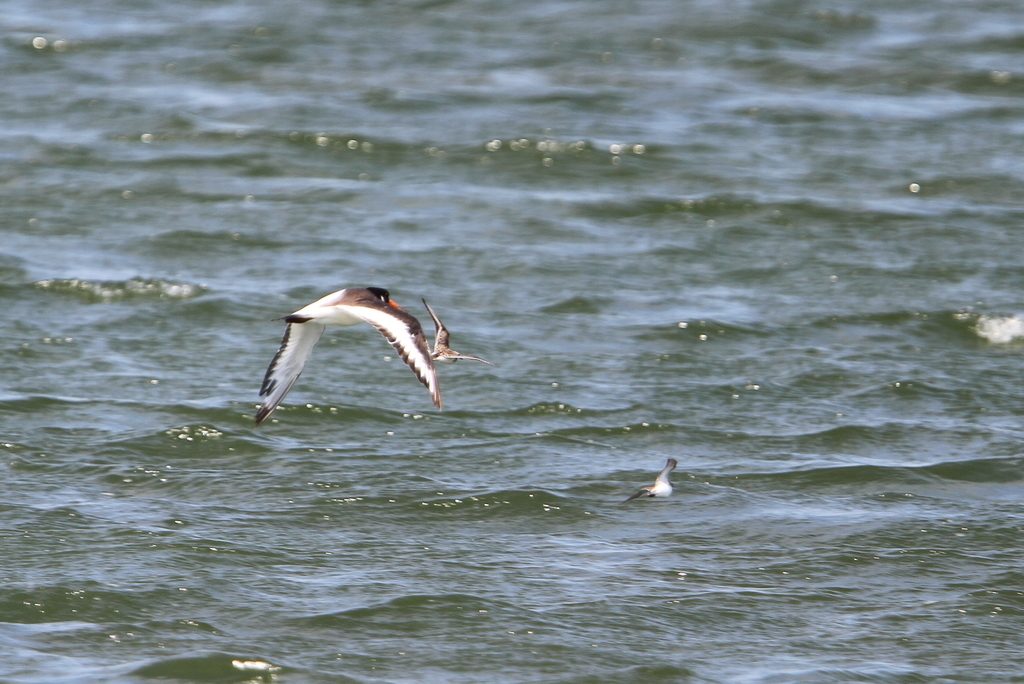
Photo: Christoph Moning · CC BY 4.0 (May be cropped or resized)
Haematopus ostralegus
Basic stats
Diet
Molluscs, worms and other invertebrates
Habitat
Coasts, estuaries and some inland lowlands
Range
Breeds across western Europe and temperate Asia to the northwestern Pacific; many populations winter farther south
Size
40–45cm
Wingspan
80–85cm
Weight
Averages about 526g
The Eurasian Oystercatcher is a large, noisy wader with black-and-white plumage, pinkish legs, red eyes and a long orange-red bill. Females tend to have longer bills than males. Adults briefly acquire a white throat collar in non-breeding plumage, while young birds are browner and retain the collar longer. White wing and tail markings are bold in flight. The species measures 40–45 cm, spans 80–85 cm and averages about 526 g (Wikipedia, general species account; AVONET, Tobias et al. 2022).
Across western Europe and temperate Asia to the northwestern Pacific, the species breeds on coasts and in some inland lowlands; many populations move south for winter and gather in estuaries. It feeds largely on molluscs, worms and other invertebrates. Broad-tipped bills can prise or hammer shellfish open, whereas pointed bills probe for worms, and individuals learn specialized techniques. Despite the name, oysters are not necessarily a major food. Outside the breeding season, the birds commonly form large, sociable flocks (Wikipedia, general species account; EltonTraits, Wilman et al. 2014).
Where to see Eurasian Oystercatcher in Spain
GBIF records grouped by protected area. They show where the species has been reported, not that it is there now, and they are not population counts.
Recorded in 19 protected areas (1879–2025). The 8 with the most records:
- Zona Húmida Protexida Ría de Ortigueira e Ladrido: 850 records (1982–2024)
- Parque Natural de la Bahía de Cádiz: 374 records (1983–2025)
- Reserva Natural Parcial de la Ría de Villaviciosa: 247 records (1879–2024)
- Parque Natural de Bahía de Cádiz: 208 records (1986–2024)
- Paraje Natural Río Palmones: 144 records (1999–2024)
- Paisaje Protegido Espacios Abiertos e Islas del Mar Menor: 99 records (2007–2024)
- Zona Húmida Protexida Ría de Ribadeo: 63 records (1987–2024)
- Pinar de la Algaida: 58 records (2014–2024)
Quick answers
- What does the Eurasian Oystercatcher eat?
- Molluscs, worms and other invertebrates
- What habitat does the Eurasian Oystercatcher live in?
- Coasts, estuaries and some inland lowlands
- Where is the Eurasian Oystercatcher found?
- Breeds across western Europe and temperate Asia to the northwestern Pacific; many populations winter farther south
- How big is the Eurasian Oystercatcher?
- 40–45cm
- What is the wingspan of the Eurasian Oystercatcher?
- 80–85cm
- How much does the Eurasian Oystercatcher weigh?
- Averages about 526g