
 Wildlife
of Spain
Red-breasted Merganser
Ducks, Geese & Swans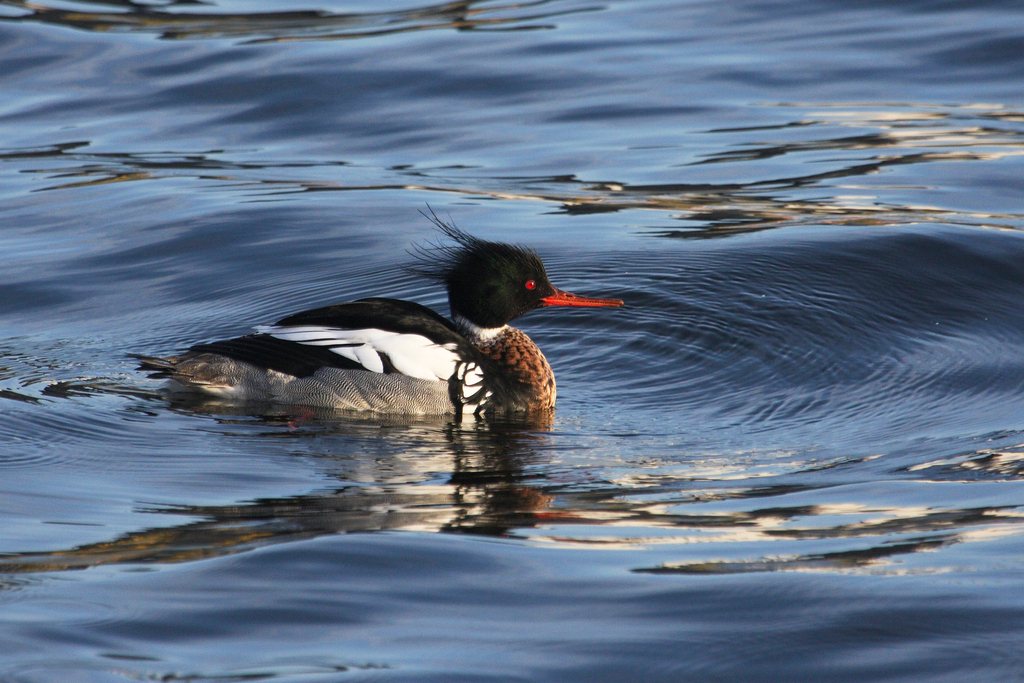
Photo: (c) Thomas Galewski, some rights reserved (CC BY) · CC-BY (May be cropped or resized)
Mergus serrator
Basic stats
Diet
Mostly small fish, with aquatic invertebrates and amphibians
Habitat
Northern freshwater lakes and rivers when breeding; chiefly coastal waters in winter
Range
Temperate and subarctic parts of the Northern Hemisphere
Clutch size
About 10 eggs
Incubation period
28–35 days
Size
51–64cm
Wingspan
66–74cm
Weight
Averages about 1015g
The Red-breasted Merganser is a streamlined diving duck with a shaggy crest and long, narrow red bill whose serrated edges help grip fish. Breeding males have a dark green-glossed head, white neck, rusty breast and patterned black-and-white body; females are grey-brown with a rusty head. It flies rapidly and pursues prey underwater. Adults measure 51–64 cm, span 66–74 cm and average about 1,015 g (Wikipedia, general species account; AVONET, Tobias et al. 2022).
Across temperate and subarctic parts of the Northern Hemisphere, the species breeds beside freshwater lakes and rivers and usually shifts to coastal waters for winter. Most populations migrate, although some oceanic groups make only short movements. Small fish dominate its food, supplemented by aquatic insects, worms, crustaceans and amphibians. The ground nest is sheltered near water and holds about ten eggs. Incubation lasts 28–35 days, and the young leave the nest within a day of hatching (Wikipedia, general species account; EltonTraits, Wilman et al. 2014; AnAge).
Where to see Red-breasted Merganser in Spain
GBIF records grouped by protected area. They show where the species has been reported, not that it is there now, and they are not population counts.
Recorded in 10 protected areas (1969–2024). The 8 with the most records:
- Zona Húmida Protexida Ría de Ortigueira e Ladrido: 154 records (1993–2024)
- Paisaje Protegido Espacios Abiertos e Islas del Mar Menor: 37 records (1969–2024)
- LIC Jaizkibel BGL: 22 records (1990–2023)
- Reserva Natural Parcial de la Ría de Villaviciosa: 11 records (1978–2024)
- Zona Húmida Protexida Ría de Ribadeo: 10 records (2003–2023)
- Parc Agrari del Baix Llobregat: 7 records (2021–2024)
- Parque Nacional Marítimo-Terrestre das Illas Atlánticas de Galicia: 6 records (2019–2022)
- Parque Natural de la Bahía de Cádiz: 6 records (1997–2017)
Quick answers
- What does the Red-breasted Merganser eat?
- Mostly small fish, with aquatic invertebrates and amphibians
- What habitat does the Red-breasted Merganser live in?
- Northern freshwater lakes and rivers when breeding; chiefly coastal waters in winter
- Where is the Red-breasted Merganser found?
- Temperate and subarctic parts of the Northern Hemisphere
- How many eggs does the Red-breasted Merganser lay?
- About 10 eggs
- How long are the eggs of the Red-breasted Merganser incubated?
- 28–35 days
- How big is the Red-breasted Merganser?
- 51–64cm
- What is the wingspan of the Red-breasted Merganser?
- 66–74cm
- How much does the Red-breasted Merganser weigh?
- Averages about 1015g