
 Wildlife
of Spain
Ruddy Turnstone
Waders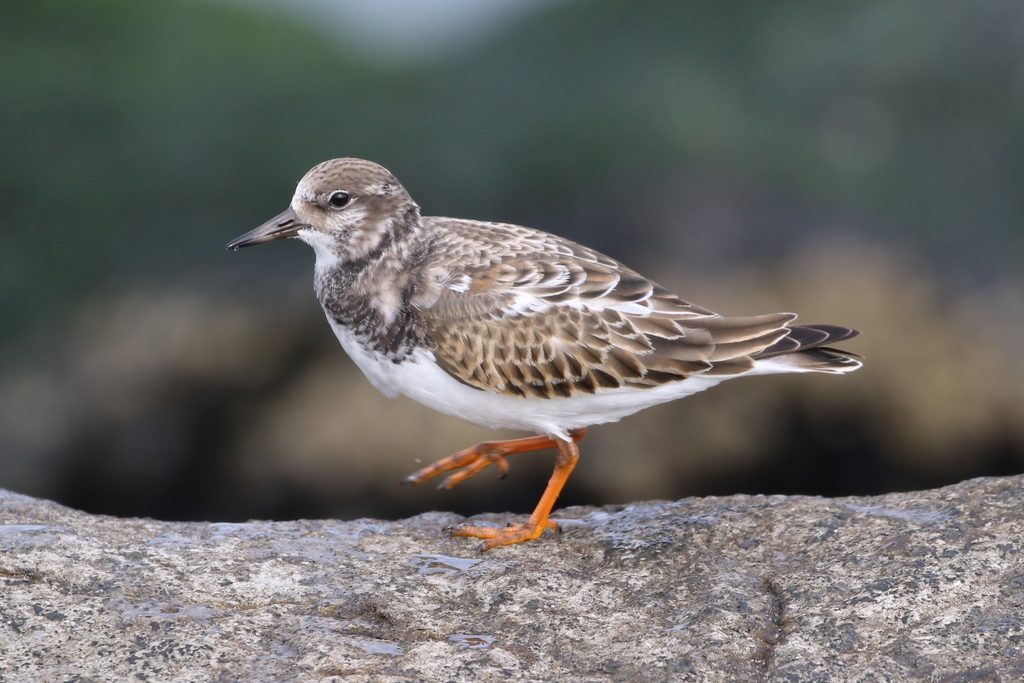
Photo: Henggang Cui · CC0 1.0
Arenaria interpres
Basic stats
Diet
Mostly invertebrates, with some plant matter, fish, carrion and eggs
Habitat
Arctic tundra near water when breeding; chiefly rocky and stony coasts at other seasons
Range
Breeds in northern Eurasia and North America; winters along coasts across much of the world
Clutch size
Usually 4 eggs
Incubation period
About 22 days
Size
22–24cm
Wingspan
50–57cm
Weight
Averages about 136g
The Ruddy Turnstone is a compact shorebird with short orange legs and a slightly upturned, wedge-shaped bill. Breeding plumage combines reddish brown, black and white in a bold pattern, while non-breeding birds are darker grey-brown above. Strong white markings across the wings, back and tail become conspicuous in flight. It measures 22–24 cm, spans 50–57 cm and averages about 136 g (Wikipedia, general species account; AVONET, Tobias et al. 2022).
Across its range, the species nests on open northern tundra near water and migrates to coasts throughout much of the world, favouring rocky shores, jetties and breakwaters outside the breeding season. It feeds mainly on invertebrates, turning stones and other objects to expose hidden prey, but also takes plant material, fish, carrion and occasionally eggs. Birds commonly forage in flocks. A typical clutch contains four eggs, incubated for about 22 days (Wikipedia, general species account; EltonTraits, Wilman et al. 2014; AnAge).
Where to see Ruddy Turnstone in Spain
GBIF records grouped by protected area. They show where the species has been reported, not that it is there now, and they are not population counts.
Recorded in 29 protected areas (1964–2026). The 8 with the most records:
- Parque Natural de Bahía de Cádiz: 902 records (1985–2024)
- Sebadales del Sur de Tenerife Marine Park: 824 records (1985–2026)
- Paisaje Protegido Espacios Abiertos e Islas del Mar Menor: 678 records (1992–2024)
- LIC Jaizkibel BGL: 576 records (1989–2024)
- Parque Natural de la Bahía de Cádiz: 426 records (1983–2025)
- Parc natural d'es Trenc i el Salobrar de Campos: 252 records (1978–2026)
- Parque Natural Bahía de Cádiz: 137 records (2009–2026)
- Zona Húmida Protexida Ría de Ortigueira e Ladrido: 103 records (1982–2024)
Quick answers
- What does the Ruddy Turnstone eat?
- Mostly invertebrates, with some plant matter, fish, carrion and eggs
- What habitat does the Ruddy Turnstone live in?
- Arctic tundra near water when breeding; chiefly rocky and stony coasts at other seasons
- Where is the Ruddy Turnstone found?
- Breeds in northern Eurasia and North America; winters along coasts across much of the world
- How many eggs does the Ruddy Turnstone lay?
- Usually 4 eggs
- How long are the eggs of the Ruddy Turnstone incubated?
- About 22 days
- How big is the Ruddy Turnstone?
- 22–24cm
- What is the wingspan of the Ruddy Turnstone?
- 50–57cm
- How much does the Ruddy Turnstone weigh?
- Averages about 136g