
 Wildlife
of Spain
Black-bellied Plover
Waders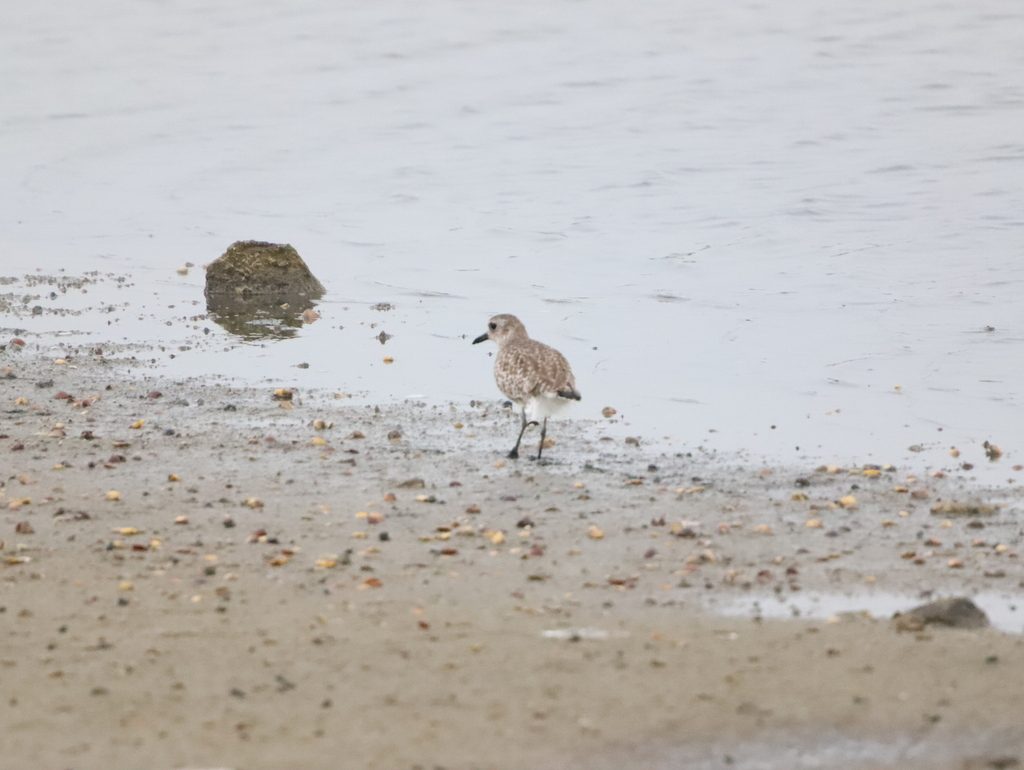
Photo: spacegecko · CC BY 4.0 (May be cropped or resized)
Pluvialis squatarola
Basic stats
Diet
Mainly molluscs, worms, crustaceans and insects, with some seeds and other plant matter
Habitat
Dry open Arctic tundra when breeding; beaches and tidal flats at other seasons
Range
Breeds around Arctic North America and Eurasia; winters on coasts nearly worldwide
Clutch size
Usually 4 eggs
Incubation period
26–27 days
Size
27–30cm
Wingspan
71–83cm
Weight
Averages about 250g
The Black-bellied Plover is a large, sturdy plover with a heavy dark bill. Breeding adults have black underparts bordered with white and black-and-white upperparts; winter birds are much plainer grey above and pale below. Black axillary feathers at the wing base remain a useful flight mark in every plumage. The white rump and barred tail are also visible in flight. Adults measure 27–30 cm, span 71–83 cm and average about 250 g (Wikipedia, general species account; AVONET, Tobias et al. 2022).
The species nests on dry, open tundra around the Arctic shores of North America and Eurasia, using a shallow scrape with good visibility. It usually lays four eggs and incubates them for 26–27 days. Long-distance migrants spread to coastal wintering grounds across most of the world, chiefly beaches and tidal flats. Birds locate prey visually, taking molluscs, worms, crustaceans and insects, with smaller amounts of seeds and other vegetation. They feed more diffusely than some related plovers but gather tightly at high-tide roosts (Wikipedia, general species account; EltonTraits, Wilman et al. 2014; AnAge).
Where to see Black-bellied Plover in Spain
GBIF records grouped by protected area. They show where the species has been reported, not that it is there now, and they are not population counts.
Recorded in 31 protected areas (1964–2026). The 8 with the most records:
- Parque Natural de Bahía de Cádiz: 998 records (1985–2025)
- Paisaje Protegido Espacios Abiertos e Islas del Mar Menor: 510 records (1992–2024)
- Parque Natural de la Bahía de Cádiz: 408 records (1986–2025)
- Zona Húmida Protexida Ría de Ortigueira e Ladrido: 392 records (1989–2024)
- Sebadales del Sur de Tenerife Marine Park: 362 records (1985–2024)
- Parc natural d'es Trenc i el Salobrar de Campos: 300 records (1978–2024)
- Paraje Natural Río Palmones: 234 records (1995–2026)
- Reserva Natural Parcial de la Ría de Villaviciosa: 223 records (1975–2024)
Quick answers
- What does the Black-bellied Plover eat?
- Mainly molluscs, worms, crustaceans and insects, with some seeds and other plant matter
- What habitat does the Black-bellied Plover live in?
- Dry open Arctic tundra when breeding; beaches and tidal flats at other seasons
- Where is the Black-bellied Plover found?
- Breeds around Arctic North America and Eurasia; winters on coasts nearly worldwide
- How many eggs does the Black-bellied Plover lay?
- Usually 4 eggs
- How long are the eggs of the Black-bellied Plover incubated?
- 26–27 days
- How big is the Black-bellied Plover?
- 27–30cm
- What is the wingspan of the Black-bellied Plover?
- 71–83cm
- How much does the Black-bellied Plover weigh?
- Averages about 250g