
 Wildlife
of Spain
Calandra Lark
Larks, Pipits & Wagtails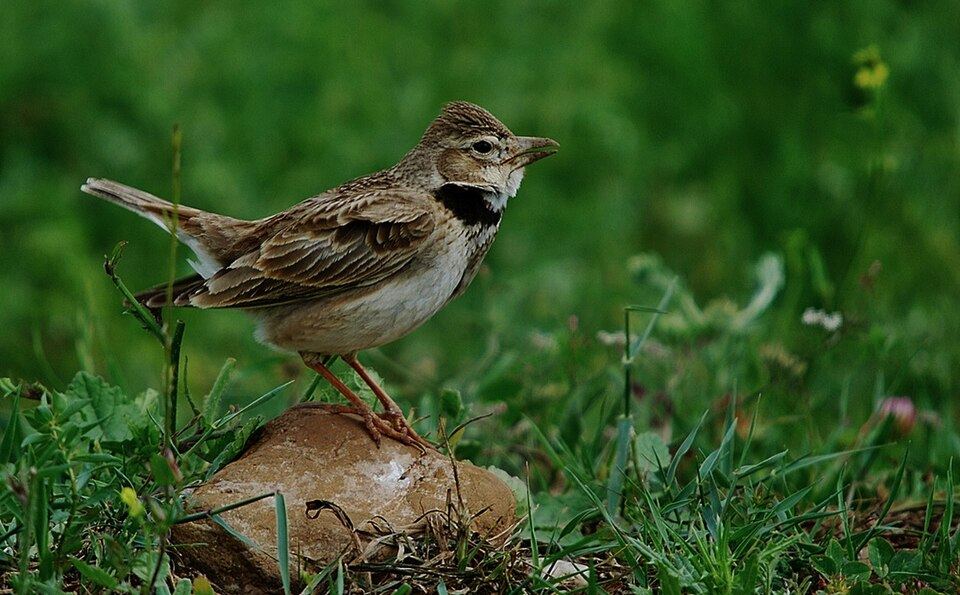
Photo: Dûrzan cîrano · CC BY-SA 3.0 (May be cropped or resized)
Melanocorypha calandra
Basic stats
Habitat
Grassland
Range
Mediterranean region through Turkey to northern Iran and southern Russia
Clutch size
3–6 eggs
Weight
62g
Calandra Lark is a large, robust lark, streaked greyish brown above and white below, with black patches on the sides of the breast and a white supercilium. In flight, its short broad wings look dark below and its short tail has white edges. The song resembles a slower skylark song. AVONET records an average mass of 62 g and mean wing length of 124 mm; EltonTraits places its feeding on the ground, with invertebrates, seeds, and plant matter represented (AVONET, Tobias et al. 2022; EltonTraits, Wilman et al. 2014).
It breeds in warm temperate areas around the Mediterranean and eastward through Turkey into northern Iran and southern Russia. Open cultivation, steppe, dry pasture, fallows, field edges, and cereal fields are typical settings. The ground nest is built in a shallow depression, often beneath a tussock, and clutches usually contain three to six eggs. Western populations are mainly resident, while Russian birds move south in winter (Wikipedia, general species account).
Where to see Calandra Lark in Spain
GBIF records grouped by protected area. They show where the species has been reported, not that it is there now, and they are not population counts.
Recorded in 31 protected areas (1964–2026). The 8 with the most records:
- Reserva Natural Dirigida de la Laguna de Gallocanta: 1,169 records (1982–2024)
- ZEC-ZEPA Laguna de Pitillas: 869 records (1984–2026)
- Zona Periférica de Protección de la Reserva Natural Dirigida de la Laguna de Gallocanta: 622 records (1987–2025)
- ZEC Peñadil - Montecillo - Monterrey KBE: 617 records (1988–2024)
- ZEPA Estepas Cerealistas de los ríos Jarama y Henares: 586 records (1985–2024)
- LIC Yesos de la Ribera Estellesa: 301 records (1997–2024)
- Réserve naturelle de la lagune de El Hito: 85 records (2007–2024)
- ZEPA Carrizales y Sotos de Aranjuez: 82 records (2019–2024)
Quick answers
- What habitat does the Calandra Lark live in?
- Grassland
- Where is the Calandra Lark found?
- Mediterranean region through Turkey to northern Iran and southern Russia
- How many eggs does the Calandra Lark lay?
- 3–6 eggs
- How much does the Calandra Lark weigh?
- 62g