
 Wildlife
of Spain
Caspian Tern
Gulls, Terns, Skuas & Auks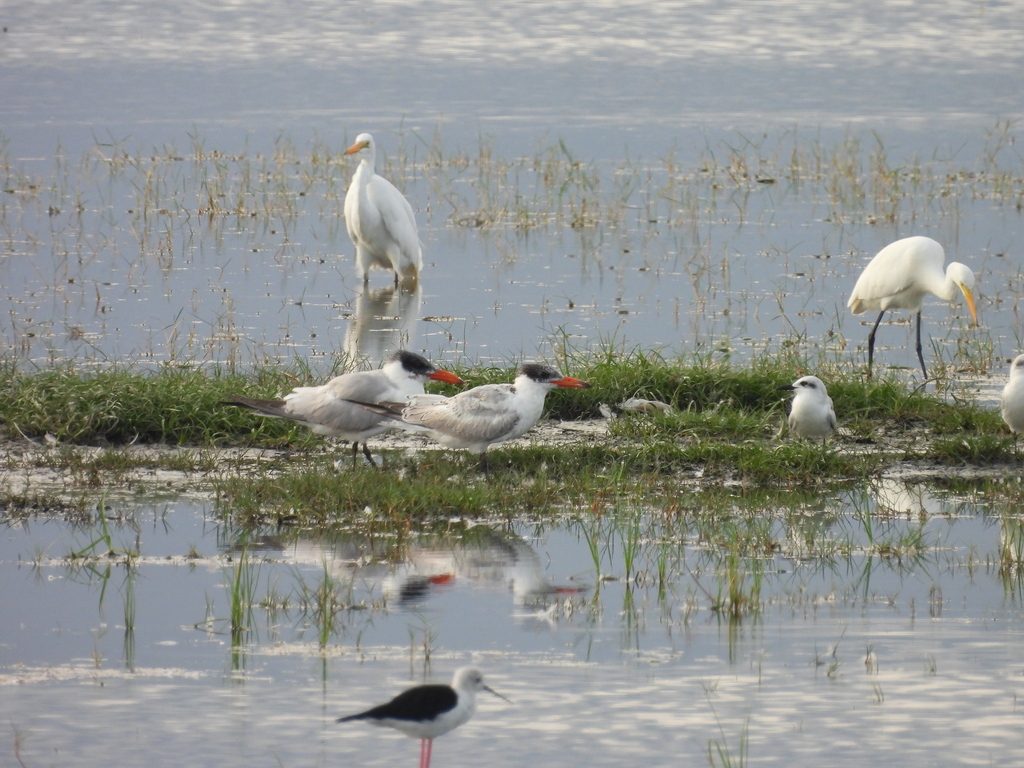
Photo: Stuart · CC0 1.0
Hydroprogne caspia
Basic stats
Diet
Mostly fish, with occasional small vertebrates and carrion
Habitat
Large lakes, rivers, lagoons, estuaries and sheltered coasts
Range
Scattered breeding distribution across North America, Europe, Africa, Asia and Australasia
Clutch size
Usually 2 eggs
Incubation period
About 21 days
Weight
Averages about 655g
The Caspian Tern is the world's largest tern, powerfully built with broad wings, a shallowly forked tail and a heavy red bill tipped dark. Adults are pale grey above and white below, with a black cap that becomes streaked outside the breeding season. Its deep, harsh call and deliberate wingbeats reinforce its robust appearance. The species averages about 655 g and has a mean wing length of roughly 410.7 mm (Wikipedia, general species account; AVONET, Tobias et al. 2022).
Across a scattered worldwide range, the species frequents large lakes, rivers, lagoons, estuaries and sheltered coasts. It searches from the air and plunge-dives for fish, which dominate its diet, though small vertebrates and carrion are sometimes taken. Nesting pairs use open ground on islands, beaches and sparsely vegetated shores, either alone or in colonies. A usual clutch contains two eggs and incubation averages about 21 days (Wikipedia, general species account; EltonTraits, Wilman et al. 2014; AnAge).
Where to see Caspian Tern in Spain
GBIF records grouped by protected area. They show where the species has been reported, not that it is there now, and they are not population counts.
Recorded in 15 protected areas (1961–2026). The 8 with the most records:
- Parque Natural de Bahía de Cádiz: 613 records (1973–2024)
- Parque Natural de la Bahía de Cádiz: 391 records (1961–2024)
- Salina de Carboneros: 80 records (1997–2024)
- Paisaje Protegido Espacios Abiertos e Islas del Mar Menor: 52 records (2007–2024)
- Parque Natural Bahía de Cádiz: 49 records (1998–2024)
- Pinar de la Algaida: 27 records (2013–2024)
- Paraje Natural Río Palmones: 24 records (2008–2026)
- Reserva Natural Parcial de la Ría de Villaviciosa: 11 records (2017–2024)
Quick answers
- What does the Caspian Tern eat?
- Mostly fish, with occasional small vertebrates and carrion
- What habitat does the Caspian Tern live in?
- Large lakes, rivers, lagoons, estuaries and sheltered coasts
- Where is the Caspian Tern found?
- Scattered breeding distribution across North America, Europe, Africa, Asia and Australasia
- How many eggs does the Caspian Tern lay?
- Usually 2 eggs
- How long are the eggs of the Caspian Tern incubated?
- About 21 days
- How much does the Caspian Tern weigh?
- Averages about 655g