
 Wildlife
of Spain
Common Greenshank
Waders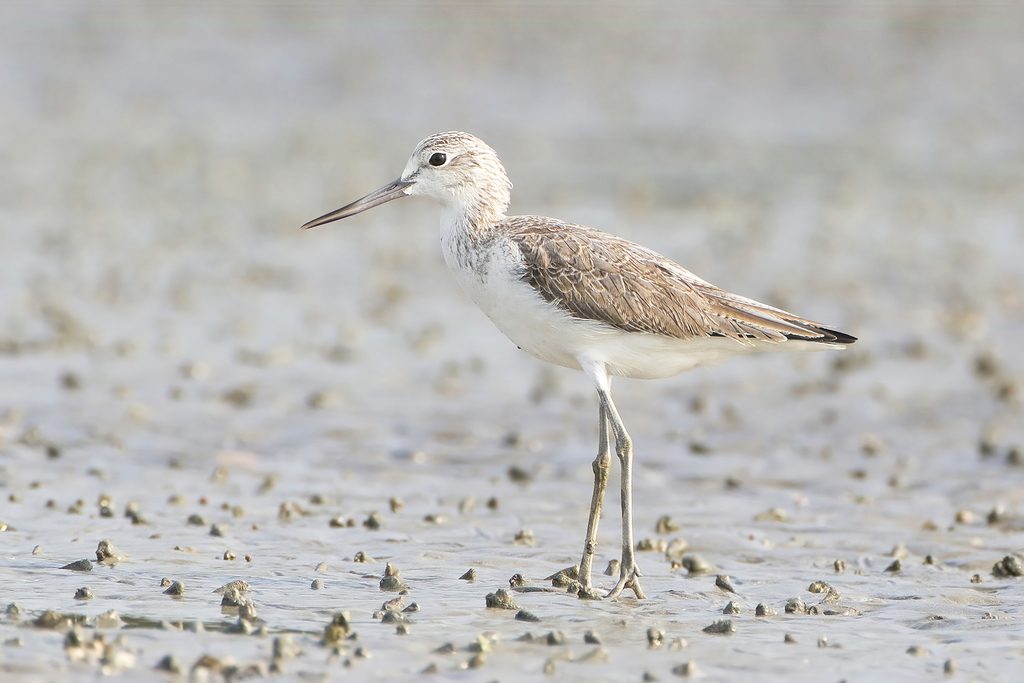
Photo: JJ Harrison · CC BY-SA 4.0 (May be cropped or resized)
Tringa nebularia
Basic stats
Diet
Mostly aquatic invertebrates, with small fish and other vertebrate prey
Habitat
Dry ground beside northern marshes when breeding; varied fresh and coastal wetlands at other seasons
Range
Breeds across northern Europe and Asia; winters in Africa, southern Asia and Australasia
Weight
Averages about 187g
The Common Greenshank is a large, elegant shank with long greenish legs and a long, slightly upturned bill. Its plumage is mostly grey-brown above and pale below, becoming more strongly streaked during breeding. A white wedge extending up the back is conspicuous when the bird flies, and its ringing three-note call is characteristic. The species averages about 187 g, with long wings suited to its strongly migratory life (Wikipedia, general species account; AVONET, Tobias et al. 2022).
Across its range, the species breeds on dry ground close to marshes from northern Europe east across northern Asia. It migrates to Africa, the Indian subcontinent and Australasia, where it occupies freshwater shallows, estuaries, lagoons and other wetlands. Feeding birds wade actively and take mainly aquatic invertebrates, along with small fish and other vertebrate prey. The nest is a simple scrape on the ground, and a clutch of about four eggs is typical (Wikipedia, general species account; EltonTraits, Wilman et al. 2014).
Where to see Common Greenshank in Spain
GBIF records grouped by protected area. They show where the species has been reported, not that it is there now, and they are not population counts.
Recorded in 40 protected areas (1964–2026). The 8 with the most records:
- Reserva Natural Parcial de la Ría de Villaviciosa: 1,158 records (1978–2026)
- Paisaje Protegido Espacios Abiertos e Islas del Mar Menor: 878 records (1985–2025)
- Zona Húmida Protexida Ría de Ortigueira e Ladrido: 850 records (1988–2024)
- Parc natural d'es Trenc i el Salobrar de Campos: 725 records (1972–2025)
- Parque Natural de Bahía de Cádiz: 648 records (1994–2025)
- Reserva Natural Dirigida de la Laguna de Gallocanta: 326 records (1980–2024)
- ZEC-ZEPA Laguna de Pitillas: 291 records (1978–2024)
- Parque Natural de la Bahía de Cádiz: 272 records (1989–2024)
Quick answers
- What does the Common Greenshank eat?
- Mostly aquatic invertebrates, with small fish and other vertebrate prey
- What habitat does the Common Greenshank live in?
- Dry ground beside northern marshes when breeding; varied fresh and coastal wetlands at other seasons
- Where is the Common Greenshank found?
- Breeds across northern Europe and Asia; winters in Africa, southern Asia and Australasia
- How much does the Common Greenshank weigh?
- Averages about 187g