
 Wildlife
of Spain
Pied Avocet
Waders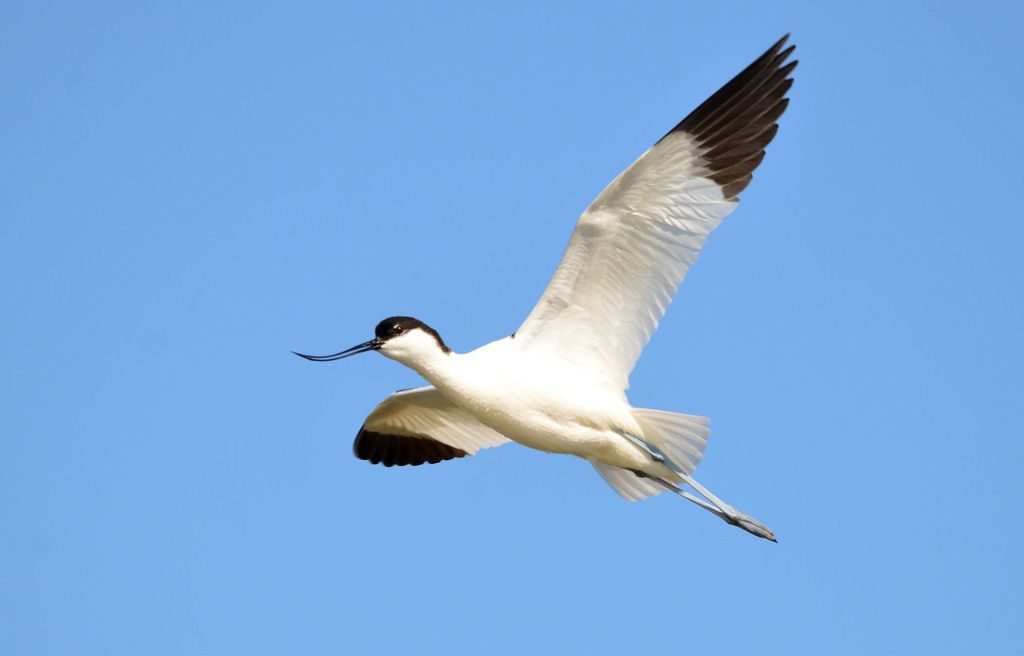
Photo: Zinogre · CC BY-SA 4.0 (May be cropped or resized)
Recurvirostra avosetta
Basic stats
Diet
Mostly aquatic invertebrates, especially crustaceans, insects, worms and molluscs
Habitat
Shallow brackish lakes, coastal lagoons, saltpans, estuaries and mudflats
Range
Widely distributed across Europe, Africa and Asia
Clutch size
Usually 3–5 eggs
Size
42–46cm
Wingspan
67–77cm
Weight
Averages about 304g
The Pied Avocet is a tall black-and-white wader with bluish legs and a slender black bill curved conspicuously upward. Its black cap and hindneck contrast with a white body, while black patches cross the shoulders and wingtips. Females tend to have a shorter, more strongly curved bill, but the sexes otherwise look alike. In flight the legs project beyond the tail. It measures 42–46 cm, spans 67–77 cm and averages about 304 g (Wikipedia, general species account; AVONET, Tobias et al. 2022).
Across its broad Old World range, the species inhabits shallow brackish lakes, lagoons, saltpans, estuaries and exposed mud. Some populations migrate while others remain near their breeding areas. Birds obtain small crustaceans, insects, worms and molluscs by sweeping the upcurved bill sideways through water or sediment, and may also peck or upend. Colonies nest on open ground near water, placing three to five eggs in a shallow lined scrape or on a low mound (Wikipedia, general species account; EltonTraits, Wilman et al. 2014).
Where to see Pied Avocet in Spain
GBIF records grouped by protected area. They show where the species has been reported, not that it is there now, and they are not population counts.
Recorded in 35 protected areas (1964–2026). The 8 with the most records:
- Parc natural d'es Trenc i el Salobrar de Campos: 1,077 records (1978–2025)
- Reserva Natural Dirigida de la Laguna de Gallocanta: 959 records (1993–2024)
- Parque Natural de Bahía de Cádiz: 769 records (1973–2026)
- Paisaje Protegido Espacios Abiertos e Islas del Mar Menor: 536 records (1983–2024)
- Zona Periférica de Protección de la Reserva Natural Dirigida de la Laguna de Gallocanta: 531 records (2012–2024)
- Parque Natural de la Bahía de Cádiz: 471 records (1983–2024)
- els Carrissars d'Elx: 448 records (2014–2024)
- Reserva Natural Laguna Salada de Pétrola: 229 records (1993–2024)
Quick answers
- What does the Pied Avocet eat?
- Mostly aquatic invertebrates, especially crustaceans, insects, worms and molluscs
- What habitat does the Pied Avocet live in?
- Shallow brackish lakes, coastal lagoons, saltpans, estuaries and mudflats
- Where is the Pied Avocet found?
- Widely distributed across Europe, Africa and Asia
- How many eggs does the Pied Avocet lay?
- Usually 3–5 eggs
- How big is the Pied Avocet?
- 42–46cm
- What is the wingspan of the Pied Avocet?
- 67–77cm
- How much does the Pied Avocet weigh?
- Averages about 304g