
 Wildlife
of Spain
Black Tern
Gulls, Terns, Skuas & Auks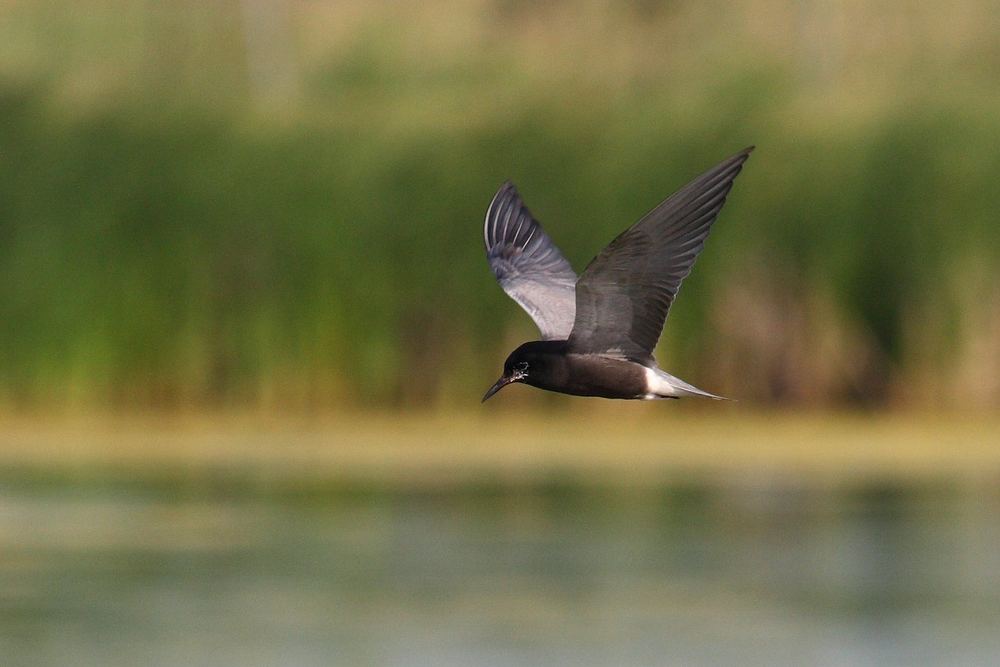
Photo: Cephas · CC BY-SA 3.0 (May be cropped or resized)
Chlidonias niger
Basic stats
Diet
Invertebrates, small fish and other small vertebrates
Habitat
Freshwater marshes when breeding; coasts and open sea in winter
Range
Breeds across northern North America, Europe and western Asia; winters along tropical coasts
Clutch size
Averages about 3 eggs
Incubation period
Averages about 21 days
Weight
Averages about 65g
The Black Tern is a small, slim marsh tern with buoyant, often erratic flight. Breeding adults have a black head and underparts, dark grey back and paler wings; outside breeding, much of the dark body plumage is replaced by white and grey. Its tail is shallow and nearly square. AVONET gives an average mass of about 65 g (Wikipedia, general species account; AVONET, Tobias et al. 2022).
It breeds on freshwater marshes across northern North America, Europe and western Asia, nesting on floating vegetation or damp ground close to water. Wintering birds move to tropical coasts and sometimes forage over open sea. The diet includes aquatic invertebrates, small fish and other small vertebrates, taken from or near the surface. Clutches average three eggs and incubation about 21 days (Wikipedia, general species account; EltonTraits, Wilman et al. 2014; AnAge).
Where to see Black Tern in Spain
GBIF records grouped by protected area. They show where the species has been reported, not that it is there now, and they are not population counts.
Recorded in 25 protected areas (1964–2024). The 8 with the most records:
- Parque Natural de la Bahía de Cádiz: 546 records (1983–2024)
- ZEC-ZEPA Laguna de Pitillas: 404 records (1983–2024)
- Reserva Natural Dirigida de la Laguna de Gallocanta: 250 records (1993–2023)
- LIC-ZEPA Embalse de las Cañas: 133 records (1987–2024)
- Zona Periférica de Protección de la Reserva Natural Dirigida de la Laguna de Gallocanta: 119 records (1988–2023)
- Parque Natural de Bahía de Cádiz: 98 records (1985–2024)
- LIC Jaizkibel BGL: 90 records (1984–2024)
- Paisaje Protegido Espacios Abiertos e Islas del Mar Menor: 54 records (2000–2024)
Quick answers
- What does the Black Tern eat?
- Invertebrates, small fish and other small vertebrates
- What habitat does the Black Tern live in?
- Freshwater marshes when breeding; coasts and open sea in winter
- Where is the Black Tern found?
- Breeds across northern North America, Europe and western Asia; winters along tropical coasts
- How many eggs does the Black Tern lay?
- Averages about 3 eggs
- How long are the eggs of the Black Tern incubated?
- Averages about 21 days
- How much does the Black Tern weigh?
- Averages about 65g